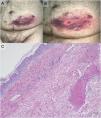
A 58-year-old man, presented with a cutaneous lesion in the left iliac fossa (Fig. 1). As a notable history, he had been hospitalized due to a subcapital fracture of the left femur 5 days prior and underwent surgery 3 days ago. Physical examination (Fig. 1A, B) revealed a contusion-like erythematous plaque measuring approximately 12cm×8cm. The lesion was slightly palpable and indurated, with a central area appearing almost black, surrounded by a faint reddish halo and a more purplish halo further out. The margins were regularly defined. Additionally, over the past 48h, the patient had developed thrombocytopenia (platelet count dropping from 320,000platelets/mL to 88,000platelets/mL). No other mucocutaneous lesions or systemic symptoms were noted. With a diagnosis of heparin-induced necrosis (HIN) in its early stages, heparin treatment was immediately discontinued and prophylactic treatment with fondaparinux was initiated. To help rule out other causes in the differential diagnosis, such as heparin-induced plaques, a punch biopsy of the central lesion was performed. The biopsy (Fig. 1C) revealed dermal vascular thrombosis with signs of early dermal necrosis and abundant hemorrhagic extravasation, confirming the diagnosis of initial HIN. The symptoms resolved within 10 days, leaving residual hyperpigmentation. It was advised to avoid low molecular weight heparin in future procedures for the patient.

Clinical presentation and histopathological examination of the lesion. (A and B) 12cm×8cm erythematous-purple plaque in the left iliac fossa measuring, with well-demarcated borders, and contusion-like appearance. (C) Dermal thrombosis, with incipient dermal necrosis and abundant hemorrhagic extravasation (Hematoxylin–eosin, 8×).
HIN is a rare complication of heparin administration. Early recognition is essential as continuation of this drug can lead to disseminated thrombotic events that may endanger the patient's life.