Multiple miliary cutaneous osteoma (MMCO) is a condition characterized by foci of heterotopic ossification in the dermis and subcutaneous tissue, occurring either primarily on previously healthy skin or, more frequently, secondarily over preexisting lesions, with acne being the most common cause.1 The mean age of onset is 51 years, with a marked female predominance (female-to-male ratio of 8:1) and lower phototypes.1 Diagnosis is based on the typical presentation of asymptomatic, skin-colored papules and nodules that are firm to palpation, variable in diameter, and predominantly located on the face. Diagnosis can be confirmed by skin biopsy or ultrasonography.1,2 Although the lesions are asymptomatic in most cases, patients often seek treatment due to cosmetic concerns.1
As this is a rare, though possibly underdiagnosed, entity,3 evidence for its treatment is based on case reports or small case series. Among these, in recent years, a treatment modality using CO2 laser incision4 has emerged, offering a high esafety and efficacy profile. We present in detail the use of this technique in a 46-year-old woman with biopsy-confirmed MMCO, achieving complete resolution without recurrence or adverse effects.
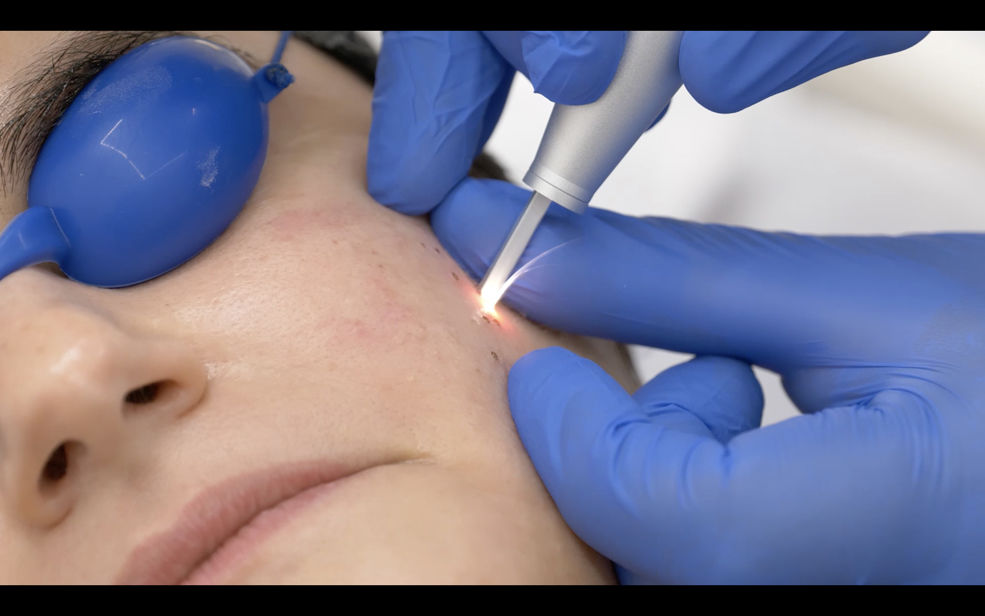
Description of the techniqueAfter applying topical anesthesia with 2.5% lidocaine and 2.5% prilocaine cream for 30min, a pinpoint incision was performed over each lesion using a CO2 laser (Secret Pro, Cutera Inc., Brisbane, CA, United States) in ultrapulsed mode, with a 0.7-mm spot size and a pulse duration of 2200 microseconds. Visualization of a spark (Fig. 1) indicated that the energy pulse had reached the lesion and that the incision depth was adequate. If necessary, additional energy pulses could be applied to enlarge the opening and facilitate extraction. The lesions were then easily removed with Adson–Kocher toothed forceps.
Complications
Expected adverse effects of treatment include pain, erythema, edema, and bleeding, which is minimal compared with conventional surgery.
On the other hand, preventable adverse effects, to some extent, include hyperpigmentation (especially in higher phototypes) and secondary infection. To prevent the former, it is important to prepare the skin with topical depigmenting agents and even oral tranexamic acid, both before and after the session, and maintain strict photoprotection following treatment. To prevent the latter, proper antiseptic technique prior to treatment is essential, along with the application of topical antibiotics (e.g., 2% fusidic acid cream) and gentle cleansing with soap and water until the crusts fall off. Herpes prophylaxis is also indicated in patients with a history of recurrent herpes infections.
ConclusionsWe describe in detail the CO2 laser treatment technique for MMCO in a 46-year-old woman, achieving a good outcome with no recurrences or adverse effects. This is a highly effective technique for this condition, offering an excellent safety profile. Because this is a rare entity with limited evidence regarding treatment, reproducible therapeutic guidelines are still needed. In this case, visualization of a spark helped ensure an adequate incision depth for lesion removal. Therefore, we propose the “spark sign” as an endpoint to assist treatment not only for MMCO but also for other ossification and calcification disorders treated with CO2 laser.
Conflict of interestThe authors declare that they have no conflict of interest.