

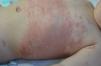

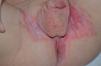
A 13-month-old infant, born at term to non-consanguineous parents and with 3 healthy siblings, was evaluated in Dermatology due to a 1-month history generalized cutaneous eruption preceded by fever and otitis externa. He had previously experienced several episodes of erythematous–scaly plaques on the trunk and skin folds and was already being followed in Otolaryngology for recurrent otitis externa and in Ophthalmology for recurrent blepharitis.
Physical examinationThe patient exhibited erythematous plaques with numerous pustules on the anterior trunk and abdomen (Fig. 1), with “punctate” hyperkeratosis on the soles of the feet and thickening of several fingernails (Fig. 2). Furthermore, there was extensive involvement in the entire genital–anal region (Fig. 3). On the cheeks, the patient exhibited erythematous macules and whitish fissures at the oral commissures. No alopecia was observed.
Histopathology


The skin biopsy showed a compact stratum corneum with focal parakeratosis and absence of the granular layer in some areas. There was mild acanthosis, slight basal spongiosis, and superficial epidermal cells with pale cytoplasm. In the dermis, there was a mild perivascular lymphohistiocytic inflammatory infiltrate with occasional polymorphonuclear leukocytes.
Additional testsDuring follow-up, immunodeficiency was ruled out by measuring immunoglobulins (IgG, IgA, IgM), complement (C3 and C4), and lymphocyte subpopulations. Zinc levels were normal, ruling out acrodermatitis enteropathica. Cultures from the lesions tested positive for Staphylococcus aureus, Streptococcus agalactiae, and Candida albicans.
Clinical course and treatmentThe patient was followed by Dermatology for 9 years starting at 13 months of age. Initially, he was treated with topical corticosteroids and antifungals, but due to recurrent episodes of generalized pustulosis—raising suspicion of pustular psoriasis—oral acitretin was started at 0.5mg/kg/day at 15 months and maintained for 1 year, achieving remission within the first month. He had occasional diaper-area and oropharyngeal candidiasis requiring antifungal treatment (oral and topical miconazole). At age 4, he was diagnosed with bilateral sensorineural hearing loss, prompting genetic testing with a hereditary deafness gene panel, which identified a heterozygous pathogenic variant c.119C>T (p.Asp50Tyr) in the GJB2 gene.
What is your diagnosis?
DiagnosisKeratitis-ichthyosis-deafness syndrome (KID Syndrome).
DiscussionWe describe a case of KID syndrome with a highly unusual cutaneous presentation (generalized pustulosis).
KID syndrome is a rare ectodermal disorder characterized mainly by hyperkeratotic cutaneous lesions, bilateral sensorineural hearing loss, and ocular involvement with vascularizing keratitis.1 The disorder is caused by a mutation in the GJB2 gene, which encodes connexin 26, a membrane protein that forms gap junctions between cells of multiple tissues, including the skin.2 Approximately 100 cases have been described in the literature—most of them sporadic—although autosomal dominant and recessive inheritance patterns have also been reported.3
The most common pathogenic variant is c.148G>A (p.Asp50Asn), present in about 80% of affected patients. Other variants, such as p.Gly45Glu or p.Ala88Val, are less common but associated with higher mortality due to sepsis and respiratory failure, respectively.4
Although the syndrome is classically defined by the triad of keratitis, ichthyosis, and deafness, patients may also present many additional clinical signs, including palmoplantar keratoderma, cicatricial alopecia, hidradenitis suppurativa, nail abnormalities with dysmorphic nails and frequent acute paronychia, dental anomalies, and systemic infections that may lead to death.5,6 Similarly, connexin 26 acts as a strong tumor-suppressor protein, which may explain the increased prevalence of squamous cell carcinoma and other cutaneous tumors in these patients.2
Currently, there is no etiologic treatment, or any clinical guidelines defining optimal management. Treatment of cutaneous lesions relies on oral retinoids, keratolytic agents, and antibiotic and antifungal therapy for secondary infections.3 Additionally, patients require ophthalmologic and otolaryngologic follow-up to monitor the other characteristic signs of the syndrome and prevent complications.
Conflict of interestThe authors declare that they have no conflict of interest.