


Patients with moderate-to-severe psoriasis have an increased risk of cardiovascular disease. Sodium-glucose cotransporter 2 (SGLT2) inhibitors provide cardiovascular benefits, but their association with cardiovascular outcomes in patients with psoriasis remains insufficiently studied.
MethodsWe conducted a retrospective cohort study using the global TriNetX research network. Patients older than 40 years with plaque psoriasis receiving biologic therapy were categorized according to SGLT2 inhibitor use. Propensity score matching was performed to balance demographic characteristics, cardiovascular risk factors, kidney disease, and concomitant antidiabetic medications.
ResultsAfter matching, 2016 patients were included in each cohort. SGLT2 inhibitor use was associated with a significantly lower incidence of acute myocardial infarction (HR, 0.601; 95%CI, 0.426–0.849), stroke (HR, 0.553; 95%CI, 0.381–0.804), heart failure (HR, 0.751; 95%CI, 0.581–0.970), peripheral artery disease (HR, 0.648; 95%CI, 0.470–0.894), and angina pectoris (HR, 0.601; 95%CI, 0.404–0.894). No significant association was observed for transient ischemic attack.
ConclusionsSGLT2 inhibitor use was associated with favorable cardiovascular outcomes in patients with moderate-to-severe psoriasis receiving biologic therapy. These findings support further prospective investigation of SGLT2 inhibitors as a potential strategy for cardiovascular risk reduction in this population.
Plaque psoriasis (PsO) is a chronic inflammatory skin disease. Its estimated prevalence is 2–4% in the general population, without differences by sex.1 Moderate-to-severe PsO has been associated with a higher prevalence of conventional cardiovascular (CV) risk factors and is also an independent CV risk factor.2
Sodium-glucose cotransporter 2 inhibitors (SGLT2is) are a class of antidiabetic drugs that inhibit glucose reabsorption in the proximal renal tubule. They have moderate antidiabetic efficacy (a reduction in glycated hemoglobin of 0.5–0.9% annually), but have demonstrated pleiotropic effects (2kg of weight loss, lower blood pressure, and cardiovascular and renal benefits), with an excellent safety profile (only an increased rate of genitourinary fungal infections has been associated with their use).3
In view of their cardiovascular benefits, we hypothesized that SGLT2i treatment in patients with moderate-to-severe PsO could reduce the incidence of cardiovascular events. No published studies have evaluated this hypothesis; therefore, we designed a study to assess the CV benefits of this treatment in psoriatic disease.
Materials and methodsWe conducted a retrospective cohort study using the global collaborative TriNetX database. We identified patients older than 40 years diagnosed with plaque PsO who were receiving biologic agents (adalimumab, infliximab, etanercept, certolizumab pegol, ustekinumab, secukinumab, ixekizumab, brodalumab, guselkumab, risankizumab, tildrakizumab, and bimekizumab), to ensure the inclusion of patients with moderate-to-severe PsO. Patients diagnosed with rheumatoid arthritis, lupus erythematosus, systemic sclerosis, antiphospholipid syndrome, or spondyloarthropathies were excluded. Eligible patients were divided into two cohorts according to whether they were on SGLT2i therapy.
Participants in both cohorts were followed longitudinally from the start of SGLT2i treatment (or from PsO diagnosis in the untreated cohort) through November 2024, with a mean follow-up of 7.86 years. We compared the incidence of acute myocardial infarction (AMI), stroke, transient ischemic attack (TIA), heart failure (HF), peripheral artery disease (PAD), and angina.
Propensity score matching (PSM) was performed to balance the 2 cohorts. Adjustment variables included demographic characteristics (age and sex), conventional CV risk factors (hypertension, diabetes mellitus, dyslipidemia, obesity, smoking, and alcohol use disorder), kidney disease (acute kidney injury, chronic kidney disease, or hypertensive nephropathy), and other antidiabetic treatments (metformin, semaglutide, liraglutide, lixisenatide, nateglinide, linagliptin, vildagliptin, and sitagliptin).
Statistical analyses were performed using the analytical tools provided by the TriNetX database. Results were considered significant at P<.05.
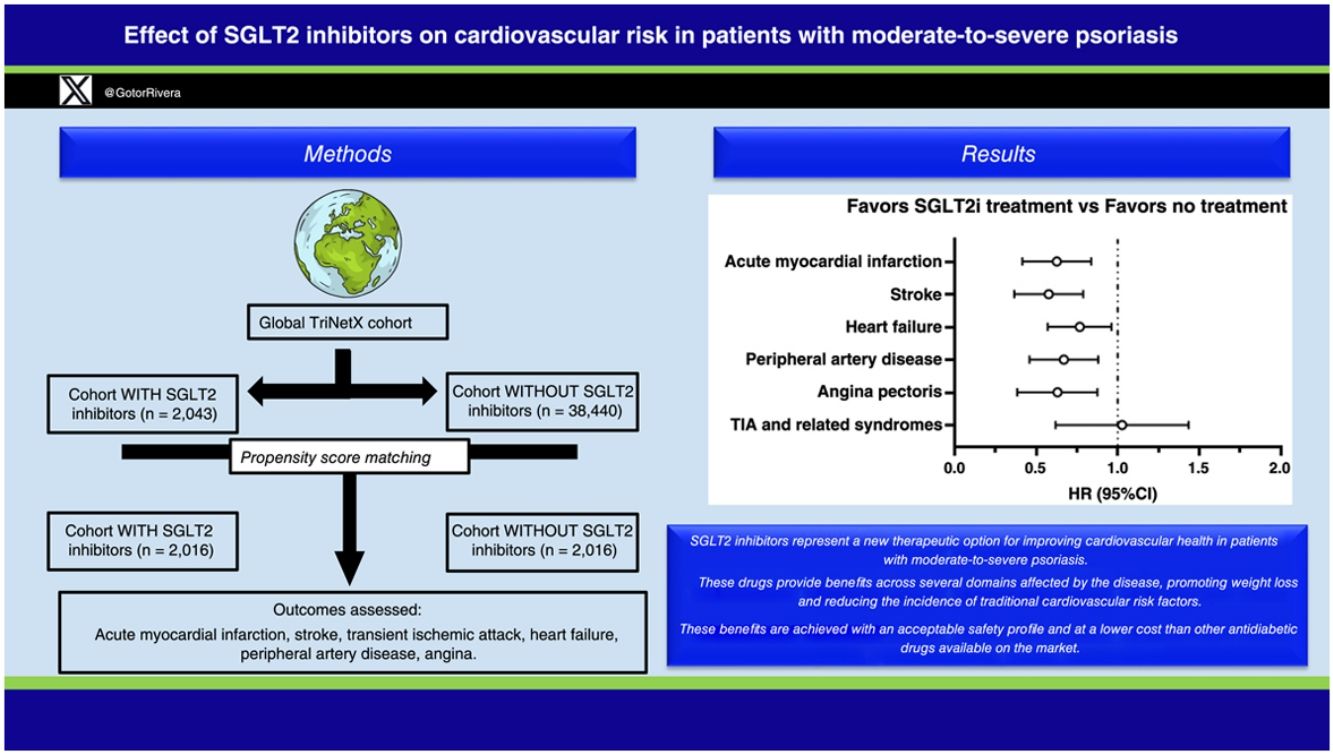
ResultsWe identified a total of 38,440 patients with PsO on biologic therapy who were not treated with SGLT2is and 2043 patients on SGLT2i therapy. After PSM, the 2 cohorts each comprised 2016 patients.
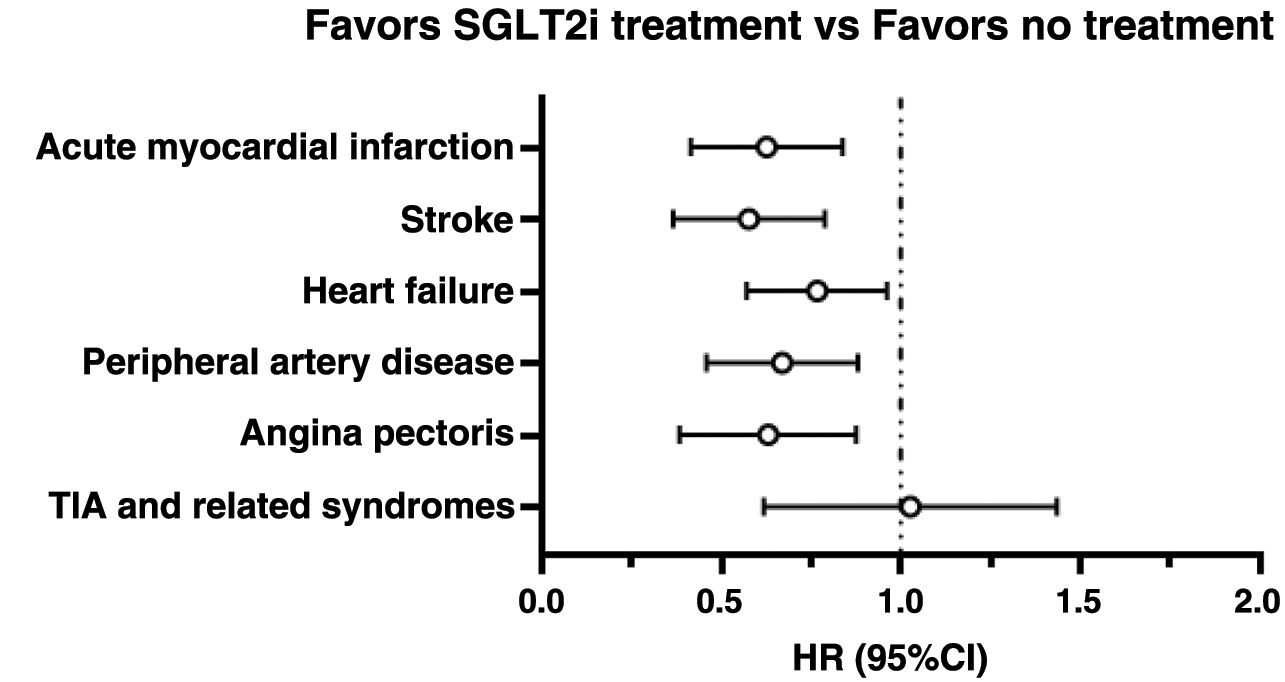
Among patients on SGLT2is, there were statistically significant reductions in the incidence of AMI (HR, 0.601; 95%CI, 0.426–0.849; P=.0035), stroke (HR, 0.553; 95%CI, 0.381–0.804; P=.016), HF (HR, 0.751; 95%CI, 0.581–0.97; P=.0276), angina pectoris (HR, 0.601; 95%CI, 0.404–0.894; P=.0110), and PAD (HR, 0.648; 95%CI, 0.47–0.894; P=.0077) (Fig. 1).
Forest plot showing the hazard ratio (HR) and 95% confidence interval (95%CI) for each event listed on the left, comparing the cohort of patients receiving SGLT2 inhibitors with patients not receiving this treatment. Confidence intervals entirely below 1 indicate a significant benefit of these drugs for the event analyzed.
No association was observed between SGLT2i treatment and the incidence of TIA (HR, 0.974; 95%CI, 0.649–1.463; P=.8988).
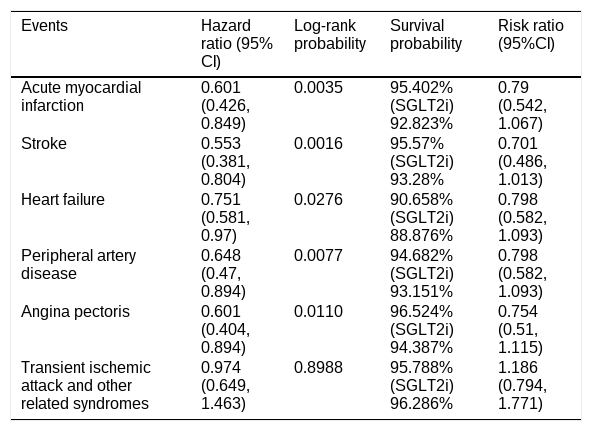
The study results are detailed in Table 1.
Study results: psoriasis vs cardiovascular events.
| Events | Hazard ratio (95%CI) | Log-rank probability | Survival probability | Risk ratio (95%CI) |
|---|---|---|---|---|
| Acute myocardial infarction | 0.601 (0.426, 0.849) | 0.0035 | 95.402% (SGLT2i) 92.823% | 0.79 (0.542, 1.067) |
| Stroke | 0.553 (0.381, 0.804) | 0.0016 | 95.57% (SGLT2i) 93.28% | 0.701 (0.486, 1.013) |
| Heart failure | 0.751 (0.581, 0.97) | 0.0276 | 90.658% (SGLT2i) 88.876% | 0.798 (0.582, 1.093) |
| Peripheral artery disease | 0.648 (0.47, 0.894) | 0.0077 | 94.682% (SGLT2i) 93.151% | 0.798 (0.582, 1.093) |
| Angina pectoris | 0.601 (0.404, 0.894) | 0.0110 | 96.524% (SGLT2i) 94.387% | 0.754 (0.51, 1.115) |
| Transient ischemic attack and other related syndromes | 0.974 (0.649, 1.463) | 0.8988 | 95.788% (SGLT2i) 96.286% | 1.186 (0.794, 1.771) |
A systematic review concluded that patients with PsO have an increased risk of ischemic heart disease, cerebrovascular disease, and peripheral artery disease,4 with an even greater risk among young patients with severe forms of the disease.5 Control of systemic inflammation could reduce this risk, as lower rates of vascular disease have been reported with methotrexate, tumor necrosis factor (TNF) inhibitors, and other biologic agents.2
Early clinical trials of SGLT2is demonstrated a benefit in the composite outcome of major adverse cardiovascular events (MACE) among patients with diabetes, with reductions of up to 26%.6 Moreover, they provide renal protection, reducing progression to macroalbuminuria (38%), new-onset albuminuria (21%), and decline in glomerular filtration rate (46%).7 These benefits have also been extended to patients without diabetes, without a history of CV disease, and regardless of baseline kidney function.8
The TriNetX database does not permit analysis of a composite outcome such as MACE. Nevertheless, our study found a benefit from SGLT2i treatment in this patient cohort, with 20–30% reductions in the incidence of stroke and PAD. Regarding AMI, although we observed a trend toward a lower incidence, it did not reach statistical significance.
In patients with HF, reductions of up to 26% in disease progression or cardiovascular death have been reported.9 This benefit has been demonstrated across this drug class, regardless of a past medical history of CV disease or diabetes.3 Our study similarly found a benefit with SGLT2i treatment. This is noteworthy because psoriasis has been suggested not only to increase CV risk but also to impair left ventricular function.10
The beneficial effects of these drugs on CV health appear to be independent of SGLT2 inhibition.11 The principal mechanism appears to involve inhibition of NLRP3 (NLR family pyrin domain containing 3) inflammasome activity in macrophages.12 Inhibition of this cytoplasmic complex would reduce production of the active forms of proinflammatory cytokines such as interleukin (IL)-1β, IL-18, IL-6, and tumor necrosis factor (TNF)-α. Inhibiting these cytokines could slow atherosclerotic plaque progression and adverse myocardial remodeling. In this study, the effect of SGLT2is on CV risk was observed in patients receiving biologic therapy, suggesting that these antidiabetic drugs may modulate an inflammatory pathway in psoriasis not fully controlled by biologic therapy.
Although these drugs have been available for several years, their use in psoriatic disease is recent. Two studies using experimental murine models of psoriasis evaluated the efficacy of topical canagliflozin 4%1 and dapagliflozin 5%, 10%, or 20%.13 Both drugs improved clinical lesions, histological changes, cytokine profiles, and markers of oxidative stress, with no significant differences compared with clobetasol propionate 0.05% cream. However, these findings must be confirmed in human studies.
The limitations of this study include its retrospective design and reliance on accurate coding of events by each patient's treating physicians. Unmeasured confounding factors not accounted for during cohort matching may have affected the findings. Moreover, we lacked information on the indications for initiating SGLT2is in the cohort with moderate-to-severe PsO. Despite these limitations, we believe this study may generate a hypothesis that should be tested in future prospective studies.
In conclusion, SGLT2is represent a potential new tool for improving CV health in patients with moderate-to-severe PsO. These drugs provide benefits across several domains affected by the disease, promoting weight loss and reducing the incidence of conventional CV risk factors. These benefits are achieved with an acceptable safety profile and at a lower cost than other antidiabetic drugs available on the market.
FundingNone declared.
Conflict of interestThe authors declare that they have no conflict of interest.