


Female androgenetic alopecia (FAGA) is the most common form of alopecia among women older than 50 years. Hormonal factors are involved in its etiopathogenesis, particularly through more active testosterone metabolites produced by the action of 5-alpha-reductase. These metabolites cause miniaturization of the hair follicle by shortening the growth, or anagen, phase, leading to follicular atrophy. Together with scalp microinflammation and the oxidative effects of free radicals due to microbial colonization or external irritants, these mechanisms contribute to the clinical signs of FAGA.1
Methylsulfonylmethane (CM5-ARI+MSM) is a dietary supplement with 5-alpha-reductase-inhibiting activity that can be used in the treatment of FAGA. Serenoa repens contains 90% saturated fatty acids, phytosterols, and bioactive compounds that have demonstrated efficacy as 5-alpha-reductase inhibitors. In one study, 6 months of treatment in patients with FAGA reduced hair loss by 56% and increased hair density by 80%.2 MSM provides sulfur for processes involved in oxidative stress and inflammation, thereby reducing both, and for amino acid synthesis required for the production of hair keratin and collagen.3
An important component of the clinical assessment of these patients is measurement of quality of life (QoL) using the Hair-Specific Skindex-29 (HSS-29). This scale is derived from a 29-item self-administered questionnaire covering 3 dimensions: functional, emotional, and symptomatic. Scores range from 0 to 100, with 0 indicating no impact and 100 indicating the greatest impact on QoL. The instrument has been validated in Spanish by Spanish dermatologists4,5 and is available through a web application.
The aim of this study was to assess QoL and clinical evolution in women with FAGA after 6 months of treatment with CM5-ARI+MSM. An observational study of routine clinical practice was conducted by volunteer Spanish dermatologists who received no remuneration. The study was approved by the ethics committee of a university hospital in Madrid (Spain). The following variables were collected: age, alopecia pattern and severity according to the Sinclair scale, and HSS-29 score, both at inclusion (visit 1) and at 6 months (visit 2), using the web application. A total of 346 patients with FAGA treated with CM5-ARI+MSM between January 1st, 2022, and January 1st, 2023, were included. Changes in QoL were evaluated using Pearson's Chi-square test.
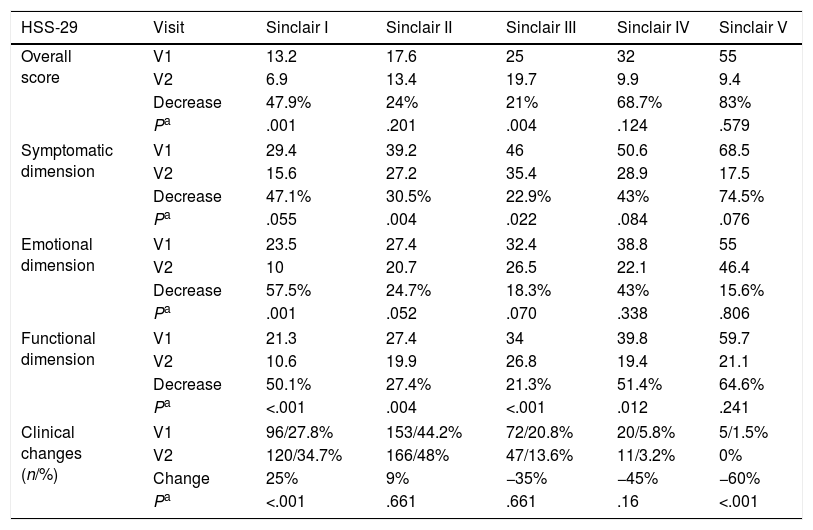
QoL improved, with a 37.7% reduction in the overall HSS-29 score (P<.001). The functional dimension showed the greatest reduction (38.4%; P<.001). Physical assessment using the Sinclair scale showed reductions in grades III, IV, and V of 35%, 45%, and 60%, respectively, toward grades I–II (P=.661, P=.16, P<.001, P<.001, and P=.661, respectively). When QoL was analyzed according to clinical Sinclair grade, the greatest percentage reduction in the overall HSS-29 score was observed in Sinclair grade V (82.95%; P=.579), followed by grade IV (68.69%). The greatest reductions in QoL impairment by dimension were 74.5% for the symptomatic dimension/Sinclair V (P=.076), 57.5% for the emotional dimension/Sinclair I (P=.001), and 64.6% for the functional dimension/Sinclair V (P=.241) (Table 1).
Changes in overall and domain HSS-29 scores according to the Sinclair scale and clinical changes.
| HSS-29 | Visit | Sinclair I | Sinclair II | Sinclair III | Sinclair IV | Sinclair V |
|---|---|---|---|---|---|---|
| Overall score | V1 | 13.2 | 17.6 | 25 | 32 | 55 |
| V2 | 6.9 | 13.4 | 19.7 | 9.9 | 9.4 | |
| Decrease | 47.9% | 24% | 21% | 68.7% | 83% | |
| Pa | .001 | .201 | .004 | .124 | .579 | |
| Symptomatic dimension | V1 | 29.4 | 39.2 | 46 | 50.6 | 68.5 |
| V2 | 15.6 | 27.2 | 35.4 | 28.9 | 17.5 | |
| Decrease | 47.1% | 30.5% | 22.9% | 43% | 74.5% | |
| Pa | .055 | .004 | .022 | .084 | .076 | |
| Emotional dimension | V1 | 23.5 | 27.4 | 32.4 | 38.8 | 55 |
| V2 | 10 | 20.7 | 26.5 | 22.1 | 46.4 | |
| Decrease | 57.5% | 24.7% | 18.3% | 43% | 15.6% | |
| Pa | .001 | .052 | .070 | .338 | .806 | |
| Functional dimension | V1 | 21.3 | 27.4 | 34 | 39.8 | 59.7 |
| V2 | 10.6 | 19.9 | 26.8 | 19.4 | 21.1 | |
| Decrease | 50.1% | 27.4% | 21.3% | 51.4% | 64.6% | |
| Pa | <.001 | .004 | <.001 | .012 | .241 | |
| Clinical changes (n/%) | V1 | 96/27.8% | 153/44.2% | 72/20.8% | 20/5.8% | 5/1.5% |
| V2 | 120/34.7% | 166/48% | 47/13.6% | 11/3.2% | 0% | |
| Change | 25% | 9% | −35% | −45% | −60% | |
| Pa | <.001 | .661 | .661 | .16 | <.001 | |
When QoL was analyzed according to clinical Sinclair grade, the overall HSS-29 score decreased, in descending order, as follows: Sinclair V, 83% (P=.579); Sinclair IV, 68.7% (P=.124); Sinclair I, 47.9% (P=.001); Sinclair II, 24% (P=.201); and Sinclair III, 21% (P=.004). The greatest reductions in QoL impairment were therefore observed in Sinclair grades IV and V. The greatest reductions in QoL impairment by dimension were 74.5% in the symptomatic dimension/Sinclair V (P=.076), 57.5% in the emotional dimension/Sinclair I (P=.001), and 64.6% in the functional dimension/Sinclair V (P=.241).
HSS-29, Hair-Specific Skindex-29. This is a 29-item self-administered questionnaire comprising 3 dimensions: functional, emotional, and symptomatic. Scores range from 0 to 100, with 0 indicating no impact and 100 indicating the greatest impact on QoL.2,3 Sinclair scale: Clinical assessment of the pattern and severity of alopecia (grades I–V, where I indicates mild disease and V indicates severe disease).
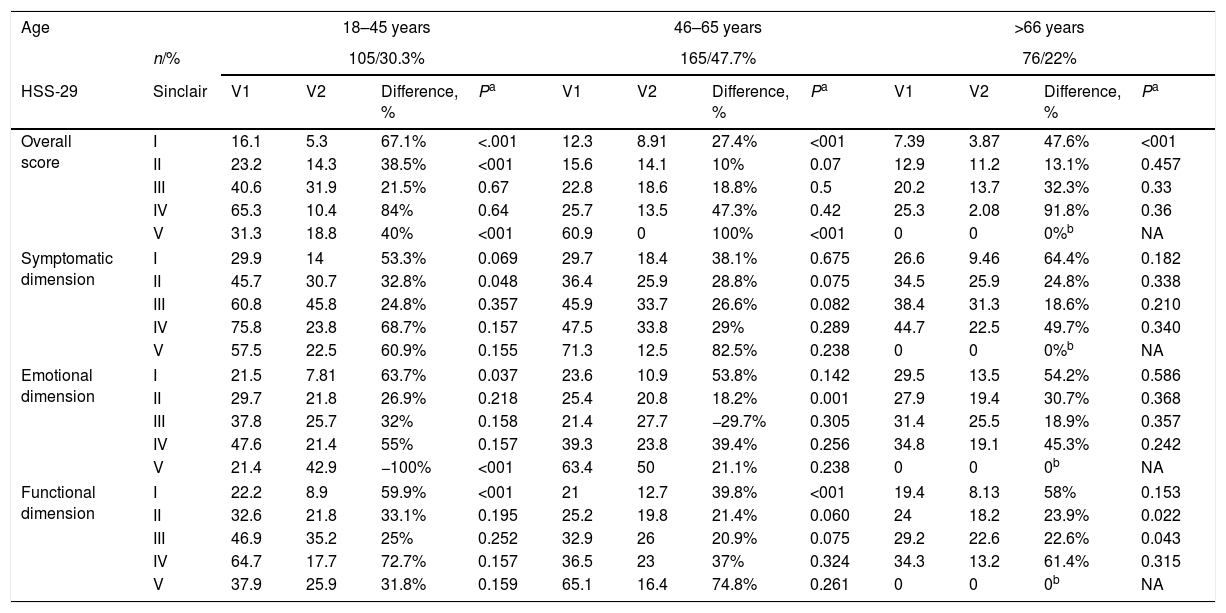
QoL according to clinical Sinclair grade improved across all age groups. Among patients aged 18–45 years, the overall HSS-29 score decreased by 84% (P=.641), with a 68.7% decrease in the symptomatic dimension (P=.157) in Sinclair grade IV. Among patients aged 46–65 years, the overall score decreased by 100%, and the symptomatic dimension decreased by 82.5% (P=.238) in Sinclair grade V. Among patients older than 66 years, the overall score decreased by 91.8% (P=.359), and the functional dimension decreased by 61.4% (P=.315) in Sinclair grade IV (Table 2).
Changes in overall and domain HSS-29 scores according to the Sinclair scale across different age groups.
| Age | 18–45 years | 46–65 years | >66 years | ||||||||||
|---|---|---|---|---|---|---|---|---|---|---|---|---|---|
| n/% | 105/30.3% | 165/47.7% | 76/22% | ||||||||||
| HSS-29 | Sinclair | V1 | V2 | Difference, % | Pa | V1 | V2 | Difference, % | Pa | V1 | V2 | Difference, % | Pa |
| Overall score | I | 16.1 | 5.3 | 67.1% | <.001 | 12.3 | 8.91 | 27.4% | <001 | 7.39 | 3.87 | 47.6% | <001 |
| II | 23.2 | 14.3 | 38.5% | <001 | 15.6 | 14.1 | 10% | 0.07 | 12.9 | 11.2 | 13.1% | 0.457 | |
| III | 40.6 | 31.9 | 21.5% | 0.67 | 22.8 | 18.6 | 18.8% | 0.5 | 20.2 | 13.7 | 32.3% | 0.33 | |
| IV | 65.3 | 10.4 | 84% | 0.64 | 25.7 | 13.5 | 47.3% | 0.42 | 25.3 | 2.08 | 91.8% | 0.36 | |
| V | 31.3 | 18.8 | 40% | <001 | 60.9 | 0 | 100% | <001 | 0 | 0 | 0%b | NA | |
| Symptomatic dimension | I | 29.9 | 14 | 53.3% | 0.069 | 29.7 | 18.4 | 38.1% | 0.675 | 26.6 | 9.46 | 64.4% | 0.182 |
| II | 45.7 | 30.7 | 32.8% | 0.048 | 36.4 | 25.9 | 28.8% | 0.075 | 34.5 | 25.9 | 24.8% | 0.338 | |
| III | 60.8 | 45.8 | 24.8% | 0.357 | 45.9 | 33.7 | 26.6% | 0.082 | 38.4 | 31.3 | 18.6% | 0.210 | |
| IV | 75.8 | 23.8 | 68.7% | 0.157 | 47.5 | 33.8 | 29% | 0.289 | 44.7 | 22.5 | 49.7% | 0.340 | |
| V | 57.5 | 22.5 | 60.9% | 0.155 | 71.3 | 12.5 | 82.5% | 0.238 | 0 | 0 | 0%b | NA | |
| Emotional dimension | I | 21.5 | 7.81 | 63.7% | 0.037 | 23.6 | 10.9 | 53.8% | 0.142 | 29.5 | 13.5 | 54.2% | 0.586 |
| II | 29.7 | 21.8 | 26.9% | 0.218 | 25.4 | 20.8 | 18.2% | 0.001 | 27.9 | 19.4 | 30.7% | 0.368 | |
| III | 37.8 | 25.7 | 32% | 0.158 | 21.4 | 27.7 | −29.7% | 0.305 | 31.4 | 25.5 | 18.9% | 0.357 | |
| IV | 47.6 | 21.4 | 55% | 0.157 | 39.3 | 23.8 | 39.4% | 0.256 | 34.8 | 19.1 | 45.3% | 0.242 | |
| V | 21.4 | 42.9 | −100% | <001 | 63.4 | 50 | 21.1% | 0.238 | 0 | 0 | 0b | NA | |
| Functional dimension | I | 22.2 | 8.9 | 59.9% | <001 | 21 | 12.7 | 39.8% | <001 | 19.4 | 8.13 | 58% | 0.153 |
| II | 32.6 | 21.8 | 33.1% | 0.195 | 25.2 | 19.8 | 21.4% | 0.060 | 24 | 18.2 | 23.9% | 0.022 | |
| III | 46.9 | 35.2 | 25% | 0.252 | 32.9 | 26 | 20.9% | 0.075 | 29.2 | 22.6 | 22.6% | 0.043 | |
| IV | 64.7 | 17.7 | 72.7% | 0.157 | 36.5 | 23 | 37% | 0.324 | 34.3 | 13.2 | 61.4% | 0.315 | |
| V | 37.9 | 25.9 | 31.8% | 0.159 | 65.1 | 16.4 | 74.8% | 0.261 | 0 | 0 | 0b | NA | |
Currently, studies evaluating QoL in FAGA using the HSS-29 before and after treatment are scarce. In the present study, QoL impairment decreased by 37.7%, with reductions of 36.7–38.7% across the different dimensions. These reductions exceeded those observed in the study by Guerra-Tapia et al.,4 in which 6 months of treatment with a 5-alpha-reductase-inhibiting nutritional supplement without MSM resulted in a 30% reduction in overall QoL impairment and reductions of 24–32% across the different dimensions.
Of note, this study did not collect all the data typically obtained in a clinical trial; nevertheless, it provides a perspective on routine dermatological practice through the use of the web-based HSS-29 to assess QoL. The lack of detailed information on the possible concomitant treatments that may have influenced the results, as well as adherence to CM5-ARI+MSM treatment, which highlights the need for further research specifically addressing the interaction between these treatments and their effects on QoL in patients with FAGA.
In conclusion, among patients with FAGA treated with CM5-ARI+MSM for 6 months, the study showed an improvement in overall QoL, particularly in the functional dimension, as well as clinical improvement according to the Sinclair scale both overall and across age groups, suggesting added value for the comprehensive treatment of this condition.
FundingThis research project was supported by a research grant from Reig Jofre Laboratories.
Conflicts of interestNone declared.
We thank Carlos Ruiz Alonso, medical advisor, for his collaboration in preparing the manuscript, and Salutis Affairs (https://salutisaffairs.com) for providing independent review support and assistance with editing and medical writing.