



Limonene hydroperoxides (Lim-OOHs) 0.2% and 0.3% and linalool hydroperoxides (Lin-OOHs) 0.5% and 1% are terpenes included in the Spanish standard and extended series. The use of both concentrations is currently being evaluated in clinical practice.
ObjectiveTo evaluate the performance of both concentrations in consecutive patch testing of patients evaluated at dermatology centers in Spain reporting to the Spanish Contact Dermatitis and Cutaneous Allergy Research Registry (REIDAC).
MethodsA multicenter, cross-sectional, observational study was conducted. Clinical and demographic characteristics were described for patients consecutively patch tested with limonene hydroperoxides (0.3% and 0.2%) and linalool hydroperoxides (1% and 0.5%) between January 2019 and December 2024. Patch test results were analyzed for each concentration, and their usefulness in clinical practice was assessed.
ResultsAmong the 10,502 patients included, the frequency of positive reactions was 2% and 4.1% to Lim-OOHs 0.2% and 0.3%, respectively, and 2.9% and 5.3% to Lin-OOHs 0.5% and 1%, respectively. The higher concentrations detected a greater number of positive, doubtful, and irritant reactions, with low concordance between concentrations. The loss of positive cases when using only the higher concentrations was limited, and the detection efficiency of the lower concentrations was low.
ConclusionsLim-OOHs 0.3% and Lin-OOHs 1% showed better diagnostic performance, with a limited loss of clinically relevant cases, and could therefore be considered more appropriate for the assessment of contact dermatitis caused by these hydroperoxides.
Los hidroperóxidos de limoneno (Lim-OOHs) 0.2% y 0.3% y linalool (Lin-OOHs) 0.5% y 1% son terpenos incluidos en las series españolas estándar y ampliada. El uso de ambas concentraciones es objeto de valoración en la práctica clínica.
ObjetivoEvaluar el comportamiento de ambas concentraciones mediante la aplicación consecutiva de pruebas epicutáneas en pacientes estudiados en los centros de Dermatología de España que reportan al Registro Español de Investigación en Dermatitis y Alergia de Contacto (REIDAC).
MétodosSe realizó un estudio observacional, transversal, multicéntrico. Se describieron las características clínicas y demográficas de los pacientes parcheados consecutivamente con hidroperóxidos de limoneno (0,3% y 0,2%) y de linalool (1% y 0,5%) entre enero 2019 y diciembre 2024. Se analizaron los resultados de las pruebas epicutáneas por cada concentración y su utilidad en la práctica clínica.
ResultadosEn 10502 pacientes incluidos, la frecuencia de reacciones positivas fue de 2% y 4.1% frente a Lim-OOHs 0.2% y 0.3%, respectivamente, y de 2.9% y 5.3% frente a Lin-OOHs 0.5% y 1%, respectivamente. Las concentraciones altas detectaron mayor número de reacciones positivas, dudosas e irritativas, con una baja concordancia entre concentraciones. La pérdida de casos positivos al emplear únicamente las concentraciones altas fue limitada y la eficiencia de detección de las concentraciones bajas fue reducida.
ConclusionesEl uso de Lim-OOHs 0.3% y Lin-OOHs 1% mostró un mejor rendimiento diagnóstico con una pérdida limitada de casos clínicamente relevantes, por lo que podrían considerarse más adecuadas para el estudio de la dermatitis por contacto por ambos hidroperóxidos.
Limonene and linalool are terpenes found in oils from citrus fruit peels, herbs, flowers, and woods, and are widely used in personal hygiene, cosmetic, industrial, and household products.1,2 These prehaptens acquire their sensitizing capacity when oxidized upon contact with air, giving rise mainly to limonene hydroperoxides (Lim-OOHs) and linalool hydroperoxides (Lin-OOHs), potent allergens capable of causing allergic contact eczema.3,4
The Spanish Registry of Research in Contact Dermatitis and Cutaneous Allergy (GEIDAC) tests both hydroperoxides at 2 concentrations: 0.2% and 0.3% for Lim-OOHs, and 0.5% and 1% for Lin-OOHs. The Spanish standard series includes the higher concentrations, whereas the Spanish extended series includes the lower ones.5,6 Positive patch test reactions are frequent in clinical practice, reaching rates of 5.0%–9.4% for Lim-OOHs 0.3% and 4.9%–11.7% for Lin-OOHs 1%.7–9 However, Lim-OOHs 0.2% and Lin-OOHs 0.5% show lower frequencies (3.4% and 2.9%, respectively).5
A greater number of doubtful reactions has been described with the lower concentrations (0.4% vs 0.6% for Lim-OOHs 0.3% vs Lim-OOHs 0.2%, respectively; 0.5% vs 0.8% for Lin-OOHs 1% vs Lin-OOHs 0.5%, respectively), whereas the percentage of irritant reactions increases with the higher concentrations (1.5% vs 0.8% for Lim-OOHs 0.3% vs Lim-OOHs 0.2%, respectively; 1.9% vs 1.2% for Lin-OOHs 1% vs Lin-OOHs 0.5%, respectively).5
Certain factors, such as age,10 sex, and location, may be associated with a higher frequency of positive reactions when the higher concentrations are used.3,6 This information is not available for the lower concentrations. Similarly, concomitant testing with fragrance markers is presumed to predict a positive result to these terpenes.11 Identifying factors associated with positivity to both hydroperoxides, in addition to concentration, would allow us to better estimate the responses.12
Recent studies have not considered the use of the lower concentrations, and their use could therefore be questioned.3 Consequently, it is appropriate to assess the performance of both concentrations to adequately identify sensitization, also taking clinical relevance into account, the interpretation of which can be complex.3 Therefore, the aim of this study was to assess the performance of testing with both concentrations of Lim-OOHs and Lin-OOHs included in the standard and extended series recommended by GEIDAC.
Material and methodWe conducted a multicenter, cross-sectional observational study using the Spanish Registry of Research in Contact Dermatitis and Cutaneous Allergy (REIDAC). The study population included all patients consecutively patch tested with Lim-OOHs (0.3% and 0.2%) and Lin-OOHs (1% and 0.5%), allergens included in the Spanish standard and extended series recommended by GEIDAC, from January 2019 through December 2024 at Dermatology centers in Spain reporting to REIDAC. The allergens were commercially obtained from Chemotechnique Diagnostics (Vellinge, Sweden). International recommendations for the study of contact eczema defined by the European Society of Contact Dermatitis (ESCD) and the International Contact Dermatitis Research Group (ICDRG) were followed. Readings were performed on day (D) 2, on D4, and, variably, on D7. Possible results were considered as follows: negative (−), irritant, doubtful (?+), weak positive (+), strong positive (++), and extreme positive (+++).13,14
The data obtained included demographic and clinical characteristics. Variables obtained included age in years by age group (0–10, 11–19, 20–64, ≥65 years), atopic dermatitis, main location, and those included in the MOAHLFA index (male [male sex], occupational dermatitis [occupational dermatitis], atopic dermatitis [atopic dermatitis], hand dermatitis [hand dermatitis], leg dermatitis [leg dermatitis], face dermatitis [face dermatitis], and age ≥40 years [age ≥40 years]). The variables obtained from the patch test results were concentration, positive reaction, irritant reaction, doubtful reaction, relevance, and sensitization to fragrance mixes (I and II), balsam of Peru, lyral, and colophony.
Statistical analysis was performed using Stata v17. Absolute and relative frequencies were used for the descriptive analysis. The chi-square test was used for bivariate analysis between categorical variables. To assess the usefulness of each concentration in detecting hypersensitivity reactions, concordance testing was performed between both concentrations for each hydroperoxide using a contingency table and the kappa index (κ). In addition, an analogous analysis was performed considering only present relevance for each allergen. A measure of diagnostic efficiency (“negative”/“positive” ratio) was estimated, defined as the number of negative results obtained with the higher concentrations required to detect one additional positive case with the lower concentrations. Finally, regression analysis was performed to estimate the relationship between the variables of interest using odds ratios (ORs). P values <.05 were considered significant for all tests.
The registry was approved by the Research Ethics Committee of Complejo Hospitalario Universitario Insular – Materno Infantil (Las Palmas, Canary Islands, Spain) (2017/964) and fully complies with the principles outlined in the Declaration of Helsinki. All patients signed informed consent to participate in the study. REIDAC collects data online using the REDCap platform (RRID: SCR_003445).
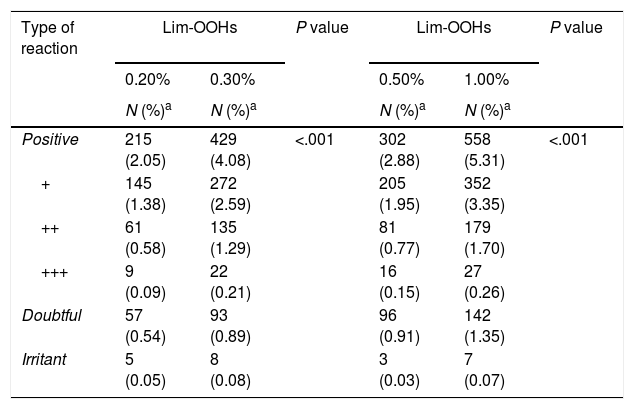
ResultsA total of 10,502 patients were included, with results available for all concentrations analyzed; 215 (2.05%) and 429 (4.10%) had a positive hypersensitivity reaction to Lim-OOHs 0.2% and 0.3%, respectively, whereas 305 (2.88%) and 558 (5.31%) had a positive reaction to Lin-OOHs 0.5% and 1%, respectively. The percentage of irritant reactions with the higher concentrations was 0.08% (Lim-OOHs 0.3%) and 0.07% (Lin-OOHs 1%), whereas with the lower concentrations, this percentage reached 0.05% (Lim-OOHs 0.2%) and 0.03% (Lin-OOHs 0.5%). Doubtful reactions for both hydroperoxides were more frequent with the higher vs the lower concentrations: 0.89% vs 0.54% (Lim-OOHs 0.3% and 0.2%, respectively) and 1.35% vs 0.91% (Lin-OOHs 1% and 0.5%, respectively).
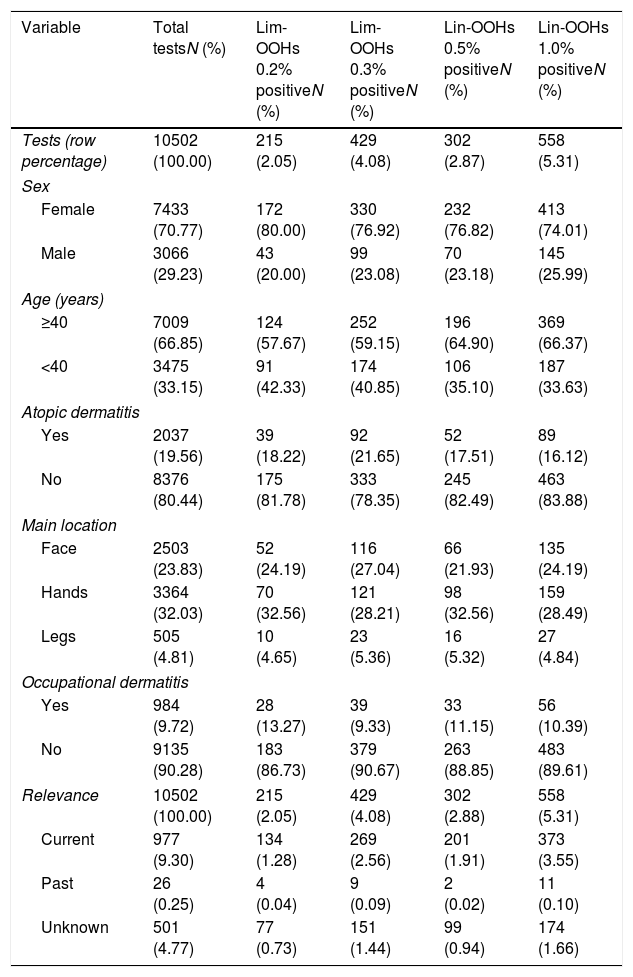
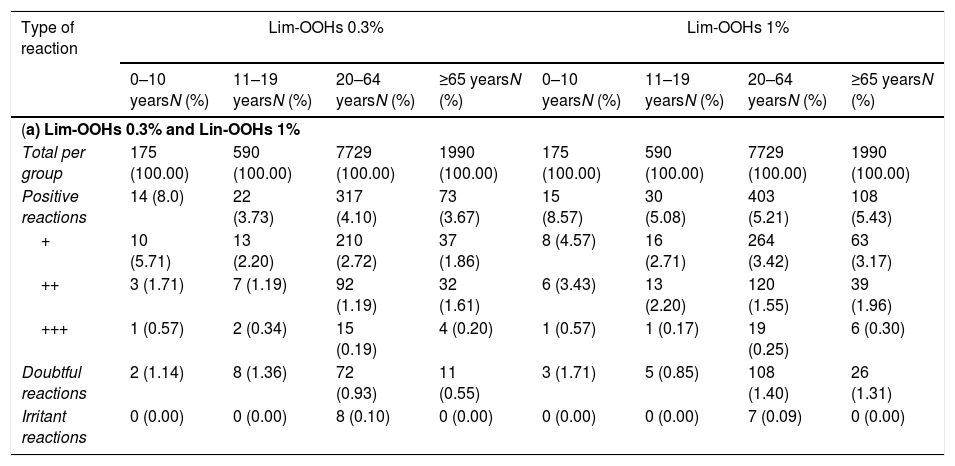
The demographic and clinical characteristics are summarized in Table 1. In all cases, with no differences between higher and lower concentrations, there was a predominance of female patients and a higher proportion of patients older than 40 years. In the analysis by age group (Table 2), the frequency of positive reactions was higher with the higher concentrations, with a greater number observed in the 20- to 64-year age group, although there was a higher concentration of positive reactions in the 0- to 10-year age group. The proportion of doubtful reactions was higher with the higher concentrations and similar in each group. Irritant reactions were uncommon in all groups.
Demographic and clinical characteristics of patients with positive reactions to Lim-OOHs (0.2% and 0.3%) and Lin-OOHs (0.5% and 1%).
| Variable | Total testsN (%) | Lim-OOHs 0.2% positiveN (%) | Lim-OOHs 0.3% positiveN (%) | Lin-OOHs 0.5% positiveN (%) | Lin-OOHs 1.0% positiveN (%) |
|---|---|---|---|---|---|
| Tests (row percentage) | 10502 (100.00) | 215 (2.05) | 429 (4.08) | 302 (2.87) | 558 (5.31) |
| Sex | |||||
| Female | 7433 (70.77) | 172 (80.00) | 330 (76.92) | 232 (76.82) | 413 (74.01) |
| Male | 3066 (29.23) | 43 (20.00) | 99 (23.08) | 70 (23.18) | 145 (25.99) |
| Age (years) | |||||
| ≥40 | 7009 (66.85) | 124 (57.67) | 252 (59.15) | 196 (64.90) | 369 (66.37) |
| <40 | 3475 (33.15) | 91 (42.33) | 174 (40.85) | 106 (35.10) | 187 (33.63) |
| Atopic dermatitis | |||||
| Yes | 2037 (19.56) | 39 (18.22) | 92 (21.65) | 52 (17.51) | 89 (16.12) |
| No | 8376 (80.44) | 175 (81.78) | 333 (78.35) | 245 (82.49) | 463 (83.88) |
| Main location | |||||
| Face | 2503 (23.83) | 52 (24.19) | 116 (27.04) | 66 (21.93) | 135 (24.19) |
| Hands | 3364 (32.03) | 70 (32.56) | 121 (28.21) | 98 (32.56) | 159 (28.49) |
| Legs | 505 (4.81) | 10 (4.65) | 23 (5.36) | 16 (5.32) | 27 (4.84) |
| Occupational dermatitis | |||||
| Yes | 984 (9.72) | 28 (13.27) | 39 (9.33) | 33 (11.15) | 56 (10.39) |
| No | 9135 (90.28) | 183 (86.73) | 379 (90.67) | 263 (88.85) | 483 (89.61) |
| Relevance | 10502 (100.00) | 215 (2.05) | 429 (4.08) | 302 (2.88) | 558 (5.31) |
| Current | 977 (9.30) | 134 (1.28) | 269 (2.56) | 201 (1.91) | 373 (3.55) |
| Past | 26 (0.25) | 4 (0.04) | 9 (0.09) | 2 (0.02) | 11 (0.10) |
| Unknown | 501 (4.77) | 77 (0.73) | 151 (1.44) | 99 (0.94) | 174 (1.66) |
Frequency of patch test reactions to Lim-OOHs and Lin-OOHs according to age group (years).
| Type of reaction | Lim-OOHs 0.3% | Lim-OOHs 1% | ||||||
|---|---|---|---|---|---|---|---|---|
| 0–10 yearsN (%) | 11–19 yearsN (%) | 20–64 yearsN (%) | ≥65 yearsN (%) | 0–10 yearsN (%) | 11–19 yearsN (%) | 20–64 yearsN (%) | ≥65 yearsN (%) | |
| (a) Lim-OOHs 0.3% and Lin-OOHs 1% | ||||||||
| Total per group | 175 (100.00) | 590 (100.00) | 7729 (100.00) | 1990 (100.00) | 175 (100.00) | 590 (100.00) | 7729 (100.00) | 1990 (100.00) |
| Positive reactions | 14 (8.0) | 22 (3.73) | 317 (4.10) | 73 (3.67) | 15 (8.57) | 30 (5.08) | 403 (5.21) | 108 (5.43) |
| + | 10 (5.71) | 13 (2.20) | 210 (2.72) | 37 (1.86) | 8 (4.57) | 16 (2.71) | 264 (3.42) | 63 (3.17) |
| ++ | 3 (1.71) | 7 (1.19) | 92 (1.19) | 32 (1.61) | 6 (3.43) | 13 (2.20) | 120 (1.55) | 39 (1.96) |
| +++ | 1 (0.57) | 2 (0.34) | 15 (0.19) | 4 (0.20) | 1 (0.57) | 1 (0.17) | 19 (0.25) | 6 (0.30) |
| Doubtful reactions | 2 (1.14) | 8 (1.36) | 72 (0.93) | 11 (0.55) | 3 (1.71) | 5 (0.85) | 108 (1.40) | 26 (1.31) |
| Irritant reactions | 0 (0.00) | 0 (0.00) | 8 (0.10) | 0 (0.00) | 0 (0.00) | 0 (0.00) | 7 (0.09) | 0 (0.00) |
| Type of reaction | Lim-OOHs 0.2% | Lin-OOHs 0.5% | ||||||
|---|---|---|---|---|---|---|---|---|
| 0–10 yearsN (%) | 11–19 yearsN (%) | 20–64 yearsN (%) | ≥65 yearsN (%) | 0–10 yearsN (%) | 11–19 yearsN (%) | 20–64 yearsN (%) | ≥65 yearsN (%) | |
| (b) Lim-OOHs 0.2% and Lin-OOHs 0.5% | ||||||||
| Total per group | 175 (100.00) | 590 (100.00) | 7729 (100.00) | 1990 (100.00) | 175 (100.00) | 590 (100.00) | 7729 (100.00) | 1990 (100.00) |
| Positive reactions | 8 (4.57) | 10 (1.69) | 166 (2.15) | 31 (1.56) | 11 (6.29) | 17 (2.88) | 217 (2.81) | 57 (2.86) |
| + | 5 (2.86) | 7 (1.19) | 117 (1.51) | 16 (0.80) | 4 (2.29) | 11 (1.86) | 154 (1.99) | 36 (1.81) |
| ++ | 3 (1.71) | 2 (0.34) | 43 (0.56) | 13 (0.65) | 6 (3.43) | 5 (0.85) | 53 (0.69) | 17 (0.85) |
| +++ | 0 (0.00) | 1 (0.17) | 6 (0.08) | 2 (0.10) | 1 (0.57) | 1 (0.17) | 10 (0.13) | 4 (0.20) |
| Doubtful reactions | 0 (0.00) | 3 (0.51) | 42 (0.54) | 12 (0.60) | 1 (0.57) | 4 (0.68) | 70 (0.91) | 21 (1.06) |
| Irritant reactions | 0 (0.00) | 0 (0.00) | 5 (0.06) | 0 (0.00) | 0 (0.00) | 0 (0.00) | 2 (0.03) | 1 (0.05) |
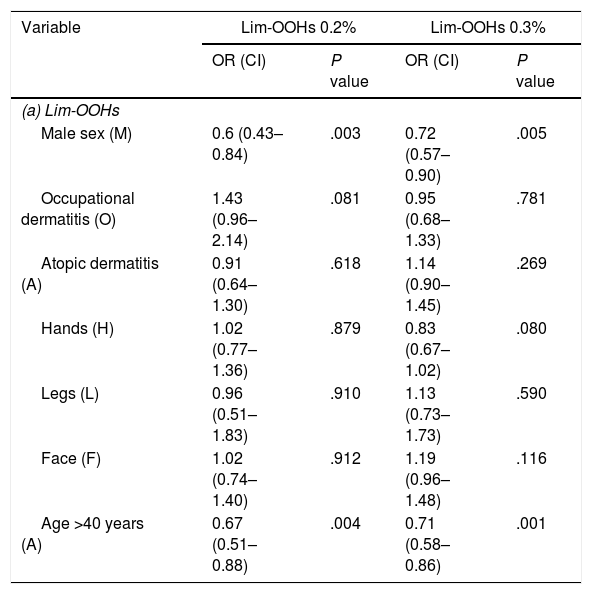
To assess whether the characteristics of the MOAHLFA index were associated with a positive hypersensitivity reaction, univariate regression analysis was performed (Table 3). Female sex was significantly associated with a positive reaction to Lim-OOHs 0.2%, Lim-OOHs 0.3%, and Lin-OOHs 0.5% (OR for male sex=0.60; 95%CI, 0.43–0.84; OR, 0.72; 95%CI, 0.57–0.90; and OR, 0.73; 95%CI, 0.55–0.95, respectively). Another factor associated with a positive reaction to Lim-OOHs was age older than 40 years, both at the 0.2% concentration (OR, 0.67; 95%CI, 0.51–0.88) and at the 0.3% concentration (OR, 0.71; 95%CI, 0.58–0.86). A past medical history of atopic dermatitis was associated with a positive reaction to Lin-OOHs 1% (OR, 0.78; 95%CI, 0.62–0.98).
Regression analysis between the MOAHLFA index and positivity to Lim-OOHs (a) and Lin-OOHs (b) according to concentration.
| Variable | Lim-OOHs 0.2% | Lim-OOHs 0.3% | ||
|---|---|---|---|---|
| OR (CI) | P value | OR (CI) | P value | |
| (a) Lim-OOHs | ||||
| Male sex (M) | 0.6 (0.43–0.84) | .003 | 0.72 (0.57–0.90) | .005 |
| Occupational dermatitis (O) | 1.43 (0.96–2.14) | .081 | 0.95 (0.68–1.33) | .781 |
| Atopic dermatitis (A) | 0.91 (0.64–1.30) | .618 | 1.14 (0.90–1.45) | .269 |
| Hands (H) | 1.02 (0.77–1.36) | .879 | 0.83 (0.67–1.02) | .080 |
| Legs (L) | 0.96 (0.51–1.83) | .910 | 1.13 (0.73–1.73) | .590 |
| Face (F) | 1.02 (0.74–1.40) | .912 | 1.19 (0.96–1.48) | .116 |
| Age >40 years (A) | 0.67 (0.51–0.88) | .004 | 0.71 (0.58–0.86) | .001 |
| Variable | Lin-OOHs 0.5% | Lin-OOHs 1.0% | ||
|---|---|---|---|---|
| OR (CI) | P value | OR (CI) | P value | |
| (b) Lin-OOHs | ||||
| Male sex (M) | 0.73 (0.55–0.95) | .020 | 0.84 (0.69–1.02) | .086 |
| Occupational dermatitis (O) | 1.17 (0.81–1.69) | .402 | 1.08 (0.81–1.44) | .592 |
| Atopic dermatitis (A) | 0.87 (0.64–1.18) | .366 | 0.78 (0.62–0.98) | .037 |
| Hands (H) | 1.02 (0.80–1.31) | .856 | 0.84 (0.69–1.01) | .063 |
| Legs (L) | 1.11 (0.67–1.86) | .681 | 1.01 (0.68–1.5) | .979 |
| Face (F) | 0.89 (0.68–1.18) | .423 | 1.02 (0.84–1.24) | .853 |
| Age ≥40 years (A) | 0.91 (0.72–1.16) | .464 | 0.98 (0.82–1.17) | .802 |
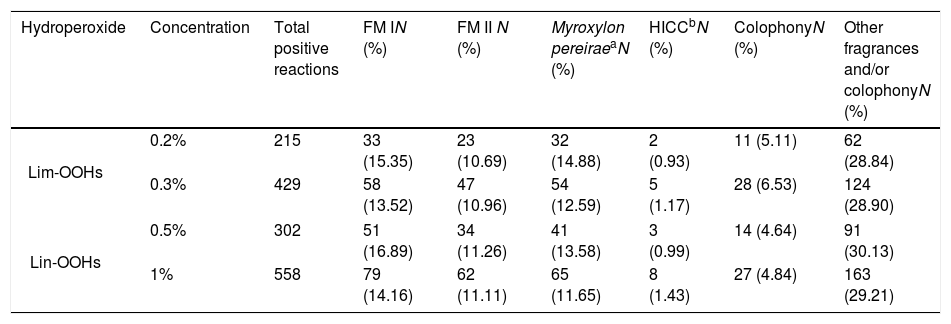
When concomitant reactions were evaluated, between 10.69% and 16.89% of positive results to balsam of Peru and fragrance mixes were obtained, with similar proportions at each concentration (Table 4). In contrast, the frequency of positive reactions to lyral was <1.43% and that to colophony <6.53%. The total number of concomitant reactions was similar for both hydroperoxides and concentrations, ranging from 28.84% to 30.13%.
Concomitant positive reactions to other fragrances in the Spanish standard series and colophony in patients with positive reactions to Lim-OOHs and Lin-OOHs.
| Hydroperoxide | Concentration | Total positive reactions | FM IN (%) | FM II N (%) | Myroxylon pereiraeaN (%) | HICCbN (%) | ColophonyN (%) | Other fragrances and/or colophonyN (%) |
|---|---|---|---|---|---|---|---|---|
| Lim-OOHs | 0.2% | 215 | 33 (15.35) | 23 (10.69) | 32 (14.88) | 2 (0.93) | 11 (5.11) | 62 (28.84) |
| 0.3% | 429 | 58 (13.52) | 47 (10.96) | 54 (12.59) | 5 (1.17) | 28 (6.53) | 124 (28.90) | |
| Lin-OOHs | 0.5% | 302 | 51 (16.89) | 34 (11.26) | 41 (13.58) | 3 (0.99) | 14 (4.64) | 91 (30.13) |
| 1% | 558 | 79 (14.16) | 62 (11.11) | 65 (11.65) | 8 (1.43) | 27 (4.84) | 163 (29.21) | |
In the bivariate analysis using the chi-square test, the higher concentrations of both hydroperoxides were significantly associated with a greater number of positive, doubtful, and irritant hypersensitivity responses. The types of reactions are detailed in Table 5.
Types of patch test reactions to Lim-OOHs and Lin-OOHs and their relationship with both concentrations.
| Type of reaction | Lim-OOHs | P value | Lim-OOHs | P value | ||
|---|---|---|---|---|---|---|
| 0.20% | 0.30% | 0.50% | 1.00% | |||
| N (%)a | N (%)a | N (%)a | N (%)a | |||
| Positive | 215 (2.05) | 429 (4.08) | <.001 | 302 (2.88) | 558 (5.31) | <.001 |
| + | 145 (1.38) | 272 (2.59) | 205 (1.95) | 352 (3.35) | ||
| ++ | 61 (0.58) | 135 (1.29) | 81 (0.77) | 179 (1.70) | ||
| +++ | 9 (0.09) | 22 (0.21) | 16 (0.15) | 27 (0.26) | ||
| Doubtful | 57 (0.54) | 93 (0.89) | 96 (0.91) | 142 (1.35) | ||
| Irritant | 5 (0.05) | 8 (0.08) | 3 (0.03) | 7 (0.07) | ||
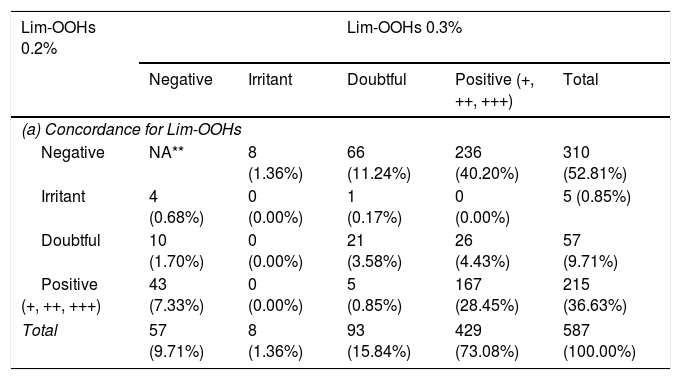
The concordance study included exclusively non-negative and independent reactions to both concentrations of each hydroperoxide, comprising 587 patients studied with Lim-OOHs and 781 with Lin-OOHs. Contingency tables (Table 6) were constructed, showing low kappa indices (κ=0.08 for Lim-OOHs and κ=0.13 for Lin-OOHs). Of the 587 cases with any result for Lim-OOHs, 215 (36.63%) tested positive to Lim-OOHs 0.2% vs 429 (73.08%) to Lim-OOHs 0.3%. Meanwhile, of the 781 with any result for Lin-OOHs, 302 (38.67%) tested positive to Lin-OOHs 0.5% vs 558 (71.44%) to Lin-OOHs 1%. Similarly, 7.33% of positive reactions to Lim-OOHs 0.2% tested negative to Lim-OOHs 0.3%, and 7.68% of positive reactions to Lin-OOHs 0.5% tested negative to Lin-OOHs 1%.
Concordance* of patch test reactions between the concentrations of Lim-OOHs (a) and Lin-OOHs (b).
| Lim-OOHs 0.2% | Lim-OOHs 0.3% | ||||
|---|---|---|---|---|---|
| Negative | Irritant | Doubtful | Positive (+, ++, +++) | Total | |
| (a) Concordance for Lim-OOHs | |||||
| Negative | NA** | 8 (1.36%) | 66 (11.24%) | 236 (40.20%) | 310 (52.81%) |
| Irritant | 4 (0.68%) | 0 (0.00%) | 1 (0.17%) | 0 (0.00%) | 5 (0.85%) |
| Doubtful | 10 (1.70%) | 0 (0.00%) | 21 (3.58%) | 26 (4.43%) | 57 (9.71%) |
| Positive (+, ++, +++) | 43 (7.33%) | 0 (0.00%) | 5 (0.85%) | 167 (28.45%) | 215 (36.63%) |
| Total | 57 (9.71%) | 8 (1.36%) | 93 (15.84%) | 429 (73.08%) | 587 (100.00%) |
| Lin-OOHs 0.5% | Lin-OOHs 1% | ||||
|---|---|---|---|---|---|
| Negative | Irritant | Doubtful | Positive (+, ++, +++) | Total | |
| (b) Concordance for Lin-OOHs | |||||
| Negative | NA** | 6 (0.77%) | 90 (11.52%) | 284 (36.36%) | 380 (48.65%) |
| Irritant | 2 (0.26%) | 1 (0.13%) | 0 (0.00%) | 0 (0.00%) | 3 (0.38%) |
| Doubtful | 12 (1.54%) | 0 (0.00%) | 44 (5.63%) | 40 (5.12%) | 96 (12.29%) |
| Positive (+, ++, +++) | 60 (7.68%) | 0 (0.00%) | 8 (1.02%) | 234 (29.96%) | 302 (38.67%) |
| Total | 74 (9.48%) | 7 (0.90%) | 142 (18.18%) | 558 (71.44%) | 781 (100.00%) |
κ=0.08; P<.001.
κ=0.13; P<.001.
The complementary clinical relevance analysis showed that, when only the higher concentrations were used, 8.13% of clinically relevant cases detected with Lim-OOHs 0.2% and 6.40% of those detected with Lin-OOHs 0.5% were missed (Supplementary Table 1).
Finally, detection efficiency showed a low yield for the lower concentrations: 175 negative results with Lim-OOHs 0.3% and 133 with Lin-OOHs 1% were required to identify 1 additional positive case with the lower concentrations.
DiscussionThe frequency of positive reactions to Lin-OOHs 0.5% and 1% was 2.88% and 5.31%, respectively, whereas that to Lim-OOHs 0.2% and 0.3% was 2.05% and 4.08%, respectively. Although these figures are similar to those previously reported by GEIDAC in a study conducted from 2015 to 2016,5,7–9,15 the results obtained with the lower concentrations were lower in this study.
Female sex predominated for both hydroperoxides, with a higher frequency when the higher concentrations were assessed, and represented a greater risk for developing positive reactions to these fragrances. This could be explained by the widespread presence of both terpenes in cosmetic products,3 along with the fact that limonene is a fragrance rarely used among men.16 Similarly, it is consistent that positivity to these hydroperoxides was not associated with occupational factors.
Although the distribution of frequencies observed by age group was similar when both concentrations were compared, the number was lower with the lower concentrations. A high number of hypersensitivity reactions to both hydroperoxides was found in patients older than 40 years, as well as in the group aged 20–64 years, because the patients evaluated fell mainly within this age range. Our results are consistent with the prevalences described in the general analysis of sensitization by age in the Spanish standard series10 and with that previously reported by GEIDAC.5 However, the highest proportion of hypersensitivity reactions was detected in children younger than 10 years, as reported by other authors.6,17 In contrast to a former study, age older than 40 years was associated with a lower risk of sensitization to Lim-OOHs.3 Overall, we found that both hydroperoxides are important allergens in pediatric patients,18–20 because of early and continuous exposure to personal care products.16 Therefore, it would be advisable to reduce or eliminate these fragrances from childcare products and to reinforce the assessment of sensitization to these terpenes in this population.
A past medical history of atopic dermatitis has not been shown to be associated with contact hypersensitivity to fragrances or to either terpene.5,21 In our study, its frequency (16%–22%) was comparable to that previously reported by GEIDAC (20%)5 and was associated with a lower probability of sensitization to Lin-OOHs 1%. However, atopic dermatitis remains a controversial factor in the development of contact allergies.5
For the evaluation of contact dermatitis with suspected fragrance involvement, patch testing with fragrance markers is recommended, including both hydroperoxides as some of the most sensitizing allergens.11,22 Former studies reported concomitant reactions between these hydroperoxides and other fragrance markers, reaching frequencies similar to ours, with the exception of lyral, for which the proportion was low. Consistently, we found that approximately one-third of patients with positive reactions to both hydroperoxides at both concentrations showed simultaneous sensitization to fragrance mixes and/or colophony,3,5,23 demonstrating that sensitization to hydroperoxides tends to be specific and is not necessarily associated with other fragrances.9 However, the frequent concomitance underscores the importance of testing other fragrance markers in patients sensitized to these terpenes.
Most positive reactions assessed with each concentration of Lim-OOHs and Lin-OOHs were weak positive reactions (+), which is consistent with the literature.3,6 Although a higher prevalence of positive reactions has been observed with the higher concentrations,5 this study also showed a significant association between these variables. On the other hand, the frequency of doubtful and irritant reactions has varied in former studies,3 and it has been estimated that there may be a greater risk of obtaining an irritant reaction with the higher concentrations, as well as of obtaining a doubtful reaction with the lower concentrations.3,5 In contrast, our results show that the higher concentrations are significantly associated with the identification of any type of reaction (positive, doubtful, or irritant). Nevertheless, irritant reactions were a rare finding (<0.1%), which is consistent with that reported in another study,24 whereas doubtful reactions were observed more frequently with the higher concentrations.
The study of contact dermatitis caused by Lim-OOHs and Lin-OOHs presents multiple challenges. It has been reported that the exclusive use of a single concentration would limit overall detection capacity.23 In this study, Lim-OOHs 0.3% and Lin-OOHs 1% detected more non-negative reactions than their lower concentrations, with low concordance between concentrations, indicating that they did not consistently identify the same individuals. These results suggest that the lower concentrations would have limited diagnostic sensitivity.
Clinical relevance is difficult to establish because it requires adequate verification of product content and explicit declaration of its components3; moreover, hydroperoxide concentrations in such products may be very low or undetectable, and therefore their sensitizing nature remains uncertain.25 Analysis of these data allowed us to contextualize our results. The loss of relevant cases when only the higher concentrations were used was limited, and the diagnostic efficiency of the lower concentrations was low; that is, a high number of negative results with the higher concentrations was required to obtain a single additional positive result with the lower concentrations. Overall, these findings indicate that the higher concentrations provide more adequate and stable identification of hypersensitivity reactions to both hydroperoxides, without clinically significant losses compared with the lower concentrations.
In addition to determining the current frequencies of hypersensitivity reactions, this study established a significant association between the reactions (positive, doubtful, and irritant) and the higher concentration of each hydroperoxide, as well as allowing comparison of the ability to classify reactions according to concentration. Our results show that Lim-OOHs 0.3% and Lin-OOHs 1% provide better diagnostic performance than their lower concentrations, with greater detection capacity and limited loss of clinically relevant cases. Therefore, the higher concentrations could be considered the preferable option for assessing sensitization to both hydroperoxides in clinical practice. Although this study was based on observational registry data, which limits the availability of information, future prospective studies could provide further evidence regarding our findings.
Authors’ contributionsNatalie Torres-Panduro: conceptualization, methodology, writing (original draft, review and editing); David Pesqué: conceptualization, investigation, methodology, writing (review and editing), project administration; Leopoldo Borrego: conceptualization, investigation, methodology, writing (review and editing), data curation, project administration; Tatiana Sanz-Sánchez: investigation, writing (review and editing); Violeta Zaragoza Ninet: investigation, writing (review and editing); Susana Córdoba Guijarro: investigation, writing (review and editing); Javier Miquel Miquel: investigation, writing (review and editing); Juan Francisco Silvestre Salvador: investigation, writing (review and editing); Ricardo González-Pérez: investigation, writing (review and editing); Inmaculada Ruíz González: investigation, writing (review and editing); Pedro Mercader-García: investigation, writing (review and editing); Esther Serra Baldrich: investigation, writing (review and editing); José Manuel Carrascosa: investigation, writing (review and editing); Mónica Munera-Campos: investigation, writing (review and editing); Francisco Javier Ortiz de Frutos: investigation, writing (review and editing); Fátima Tous Romero: investigation, writing (review and editing); Mercedes Rodríguez Serna: investigation, writing (review and editing); María Elena Gatica Ortega: investigation, writing (review and editing); Carmen Paredes Suárez: investigation, writing (review and editing); Francisco José Navarro Triviño: investigation, writing (review and editing); Pablo Chicharro: investigation, writing (review and editing); Marta Andreu-Barasoain: investigation, writing (review and editing); Araceli Sánchez Gilo: investigation, writing (review and editing); José Juan Pereyra Rodríguez: investigation, writing (review and editing); María Antonia Pastor Nieto: investigation, writing (review and editing); Gemma Melé-Ninot: investigation, writing (review and editing); Cristina Barrabés-Torrella: investigation, writing (review and editing); Paloma Sánchez-Pedreño Guillén: investigation, writing (review and editing); Miguel Lova Navarro: investigation, writing (review and editing); Enrique Gómez de la Fuente: investigation, writing (review and editing); Marta Elosua-González: investigation, writing (review and editing); Miguel Ángel Descalzo: conceptualization, investigation, methodology, formal analysis, writing (review and editing), project administration; Ignacio García Doval: conceptualization, investigation, methodology, formal analysis, writing (review and editing), project administration; Ana María Giménez-Arnau: conceptualization, investigation, methodology, writing (review and editing), funding acquisition, project administration.
Ethical responsibilitiesThe REIDAC study was approved by the Research Ethics Committee of Complejo Hospitalario Universitario Insular – Materno Infantil (Las Palmas, Canary Islands, Spain) (CEIm-CHUIMI-2017/964). Written informed consent was obtained from all participants prior to their inclusion in the study.
Informed consentWritten informed consent was obtained from all participants prior to their inclusion in the study.
Declaration of generative AI and AI-assisted technologies in the writing processThe authors declare that no generative artificial intelligence or AI-assisted technologies were used in the writing process of this work.
FundingThe Spanish Registry of Research in Contact Dermatitis and Cutaneous Allergy (REIDAC) is supported by Fundación Piel Sana of Academia Española de Dermatología y Venereología (AEDV) and receives funding from the Agencia Española de Medicamentos y Productos Sanitarios and pharmaceutical companies (Sanofi and LeoPharma). GlaxoSmithKline and Novartis have previously collaborated. The collaborating pharmaceutical companies did not participate in any of the following processes: study design and conduct; data collection, management, analysis, and interpretation; manuscript preparation, review, and approval; or the decision to submit it for publication.
Conflict of interestsAna M. Giménez-Arnau is or has recently been a speaker and/or advisor and/or has received research funding from Almirall, Amgen, AstraZeneca, Avène, BluePrint, Celltrion, Celldex, Escient Pharmaceuticals, Genentech, GSK, Harmonic Bio, Incyte, Instituto Carlos III-FEDER, Jaspers, Leo Pharma, Menarini, Mitsubishi Tanabe Pharma, Noucor, Novartis, Sanofi-Regeneron, Septerna, Servier, Thermo Fisher Scientific, and Uriach Pharma.
Marta Elosua-González has participated as an investigator, speaker, or consultant for AbbVie, Lilly, Galderma, Leo Pharma, Pfizer, ISDIN, Almirall, Novartis, UCB Pharma, and Sanofi Genzyme.
The remaining authors declare no conflicts of interest whatsoever relevant to the content of this manuscript.
The following are the supplementary data to this article: