



Cryotherapy is a well-established treatment for common warts. However, the efficacy of bleomycin in the treatment of this condition is less well established. Therefore, we conducted a meta-analysis to compare the efficacy of bleomycin versus cryotherapy for the treatment of common warts.
MethodsPubMed, Scopus, and Cochrane databases were searched for randomized controlled trials that compared bleomycin with cryotherapy for the management of common warts and reported the outcomes of (1) lack of complete clinical clearance at the patient level (patients with at least 1 residual wart at the end of follow-up) and (2) proportion of warts not completely cleared at the lesion level. Heterogeneity was examined using the I2 statistic. A random-effects model was used for outcomes with high heterogeneity.
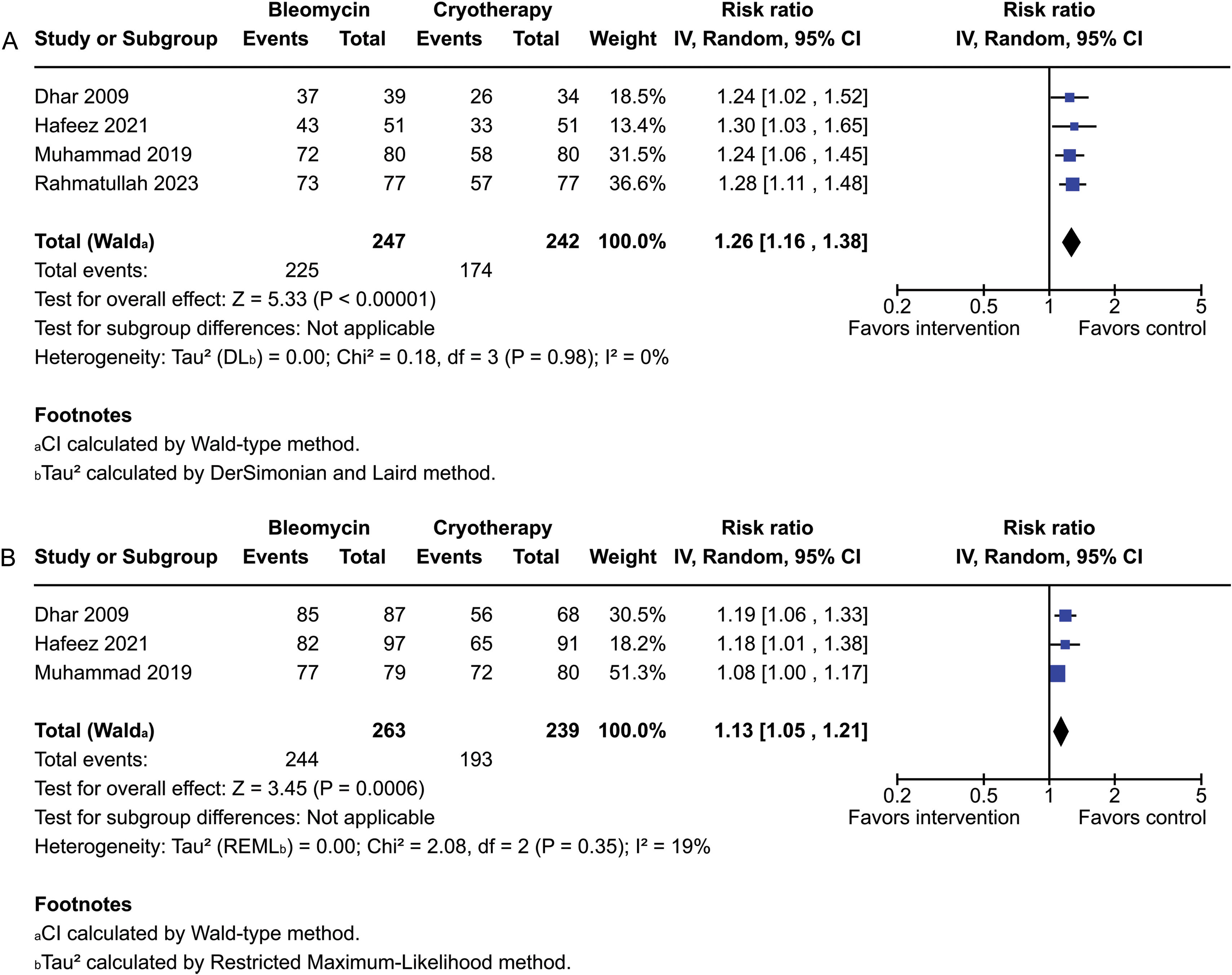
ResultsWe included 4 randomized controlled trials (RCTs) with 489 patients, of whom 247 (50.2%) received bleomycin. Follow-up intervals ranged from 2 to 3 weeks, with a maximum follow-up of 12 weeks; therefore, only short-term outcomes were available. Lack of complete clinical clearance at the patient level (RR, 1.26; 95%CI, 1.16–1.38; P<.00001; Fig. 1A) and the proportion of warts not completely cleared at the lesion level (RR, 1.13; 95%CI, 1.05–1.21; P=.0006; Fig. 1B) were significantly more common in patients treated with cryotherapy than in those treated with bleomycin.
ConclusionsIn patients with common warts, intralesional bleomycin may be associated with higher short-term clearance than cryotherapy. However, these short-term findings are based on a very small number of heterogeneous randomized controlled trials with follow-up of up to 12 weeks, and recurrence and long-term cure could not be assessed. The certainty of the evidence is therefore low, and the results should be interpreted with great caution. In clinical practice, any potential gain in short-term clearance with intralesional bleomycin needs to be weighed against its greater procedure-related pain and local adverse events, as well as factors such as accessibility, clinical expertise, and individual patient preferences.
Cutaneous warts are manifestations of human papillomavirus (HPV) infection of keratinocytes. The clinical appearance of cutaneous warts varies depending on the type of HPV involved and the location of the infection on the skin.1,2
There is no single treatment that is 100% effective. A broad range of therapeutic modalities has been used, including topical keratolytic agents such as salicylic acid, cantharidin-based preparations, immunotherapy (e.g., contact sensitizers and intralesional antigens), laser-based techniques, and topical chemotherapeutic agents such as 5-fluorouracil or tirbanibulin, among others.1,3 Among the therapies with the highest reported efficacy rates and the widest use in dermatologic practice are cryotherapy with liquid nitrogen and intralesional bleomycin.3
Cryotherapy with liquid nitrogen consists of cooling a target lesion to subzero temperatures, causing tissue ischemia and the formation of intracellular ice crystals, with subsequent rupture of the cell membrane due to osmotic damage.4 The open technique, in which liquid nitrogen is sprayed onto the target lesion, is the most commonly used. This treatment has the advantage of being easy to apply, but it requires several sessions. Because of their relative resistance to treatment, cutaneous warts may require 2 freeze–thaw cycles.5
Bleomycin is a cytotoxic agent with antitumor, antibacterial, and antiviral activity that disrupts DNA synthesis. Intralesional administration causes keratinocyte apoptosis, endothelial cell sclerosis, and inhibition of collagen synthesis. It is administered by direct injection into the lesion, microneedles, bifurcated needle prick, or dermojet procedures.6,7 The reported cure rate for cryotherapy ranges from 39% to 82%, whereas cure rates for bleomycin range from 14% to 99%.8
To date, 4 published randomized controlled trials have compared these 2 interventions for the management of cutaneous warts at different locations. Other randomized trials have compared these and other modalities (such as salicylic acid, immunotherapy, or laser therapy) in different pairwise combinations; however, they do not directly address the specific comparison between intralesional bleomycin and cryotherapy. This investigation was therefore conducted, following a prespecified and prospectively registered protocol, to address the knowledge gap regarding the comparative effectiveness of intralesional bleomycin versus cryotherapy for the treatment of cutaneous warts.
Materials and methodsEligibility criteriaThis systematic review and meta-analysis were performed and reported in accordance with the Cochrane Handbook for Systematic Reviews of Interventions and the Preferred Reporting Items for Systematic Reviews and Meta-Analyses (PRISMA) Statement guidelines.
Inclusion in this meta-analysis was restricted to studies that met all of the following eligibility criteria: (1) randomized trials; (2) direct comparison of intralesional bleomycin vs cryotherapy; (3) enrollment of patients with common warts; and (4) follow-up intervals of at least 2 weeks. In addition, studies were included only if they reported any of the clinical outcomes of interest. We excluded studies with (1) no control group; (2) an observational design; and (3) patients previously treated with another strategy. Randomized clinical trials in which bleomycin or cryotherapy was compared with other wart treatments (e.g., salicylic acid, cantharidin, immunotherapy, laser, or topical chemotherapeutic agents) were not eligible because they address different comparative questions and would require a broader (e.g., network) meta-analytic framework beyond the scope of the present protocol, which was specifically designed to assess the direct comparison between intralesional bleomycin and cryotherapy.
Search strategy and data extractionWe systematically searched PubMed, Scopus, and the Cochrane Central Register of Controlled Trials from inception to March 2025 using the following search strategy: (((((((wart) OR (warts)) OR (genital warts)) OR (plantar warts)) OR (condyloma)) OR (verruca vulgaris)) AND (((cryotherapy) OR (cryosurgery)) OR (cutaneous cryosurgery))) AND ((bleomycin) OR (chemotherapy)). The reference lists of all included studies, previous systematic reviews, and meta-analyses were also searched manually for additional studies. Two authors (D.L. and C.P.) independently extracted the data according to predefined search criteria and quality assessment.
For each included trial, we collected data on baseline characteristics, details of the intervention and comparator (including bleomycin concentration, number of sessions, administration technique, and cryotherapy protocol), efficacy outcomes, and reported adverse events. The prospective meta-analysis protocol was registered in PROSPERO on April 18, 2025, under protocol No. 1035485.
EndpointsThe primary efficacy endpoint was lack of complete clinical clearance at the patient level, defined as the proportion of patients who did not achieve complete disappearance of all treated warts at the end of the follow-up period (i.e., patients with at least 1 residual wart).
The secondary efficacy endpoint was the proportion of warts not completely cleared at the lesion level, defined as the proportion of individual treated warts that remained present or showed only partial improvement at the end of follow-up among all warts treated in each group.
These outcomes were chosen because they reflect clinically relevant treatment failure at both the patient and lesion levels in the context of multiple warts, in which partial responses are common.
Safety outcomes included local adverse events (e.g., treatment-related pain, erythema, edema, pigmentary changes, blistering, ulceration or necrosis, and scarring) and any reported systemic adverse events temporally related to the study treatments.
Quality assessmentQuality assessment of the RCTs was performed using the Cochrane Collaboration tool for assessing risk of bias in randomized trials, in which studies are classified as being at high, low, or unclear risk of bias in 5 domains: selection, performance, detection, attrition, and reporting biases. Given the small number of included trials (n=4), publication bias could not be reliably assessed.
Statistical analysisThis systematic review and meta-analysis were performed in accordance with the Cochrane Collaboration and the Preferred Reporting Items for Systematic Reviews and Meta-Analyses (PRISMA) Statement guidelines. Relative risks (RRs) with 95%CIs were used to compare treatment effects for categorical endpoints. The Cochran Q test and I2 statistic were used to assess heterogeneity; P<.10 and I2>25% were considered indicative of significant heterogeneity. We used a fixed-effect model for outcomes with low heterogeneity (I2<25%). Otherwise, a DerSimonian–Laird random-effects model was used.
Given the anticipated clinical heterogeneity in bleomycin concentration, number of sessions, and administration techniques, as well as in cryotherapy protocols, all intralesional bleomycin regimens and cryotherapy regimens were considered to belong to the same intervention class. The use of random-effects models when heterogeneity was present allowed for between-study variability while still providing an overall pooled estimate of the comparative effect. Review Manager 5.3 (Cochrane Centre, The Cochrane Collaboration, Denmark) was used for statistical analysis.
Sensitivity analysisWe performed leave-one-out sensitivity analyses to ensure that the results were not dependent on a single study.
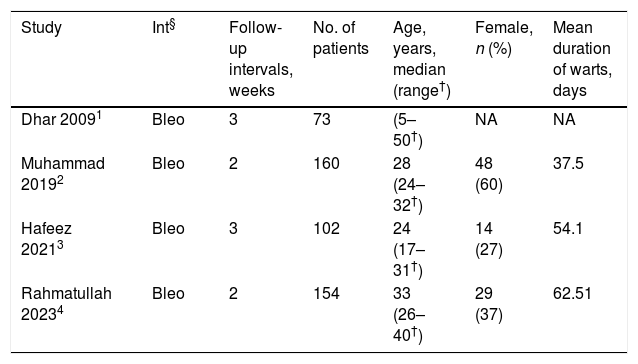
ResultsStudy selection and characteristicsAs detailed in Supplementary Fig. 1, the initial search yielded 756 results. After removal of duplicate records and ineligible studies, 10 remained and were fully reviewed according to the inclusion criteria. Of these, a total of 4 studies were included, comprising 489 patients from 4 randomized controlled trials (RCTs). A total of 247 (50.5%) patients received bleomycin and 242 (49.4%) received cryotherapy. Study characteristics are summarized in Table 1.
Baseline characteristics of included studies.
| Study | Int§ | Follow-up intervals, weeks | No. of patients | Age, years, median (range†) | Female, n (%) | Mean duration of warts, days |
|---|---|---|---|---|---|---|
| Dhar 20091 | Bleo | 3 | 73 | (5–50†) | NA | NA |
| Muhammad 20192 | Bleo | 2 | 160 | 28 (24–32†) | 48 (60) | 37.5 |
| Hafeez 20213 | Bleo | 3 | 102 | 24 (17–31†) | 14 (27) | 54.1 |
| Rahmatullah 20234 | Bleo | 2 | 154 | 33 (26–40†) | 29 (37) | 62.51 |
NA, not available.
Lack of complete clinical clearance at the patient level was significantly more common in patients treated with cryotherapy than in those treated with bleomycin (RR, 1.26; 95%CI, 1.16–1.38; P<.00001; I2=0%; Fig. 1A). Similarly, the proportion of warts not completely cleared at the lesion level was higher in the cryotherapy group (RR, 1.13; 95%CI, 1.05–1.21; P=.0006; I2=19%; Fig. 1B). There was a statistically significant difference between groups.

(A) Lack of complete clinical clearance at the patient level was significantly more common in patients treated with cryotherapy than in those treated with bleomycin. (B) Forest plot showing the proportion of warts not completely cleared at the lesion level, which was significantly higher in patients treated with cryotherapy than in those treated with bleomycin.
All 4 RCTs reported local adverse events related to the study interventions, although definitions and grading systems varied across studies. The most frequent adverse event in both groups was procedure-related pain. In general, pain during and shortly after the procedure was more intense in the intralesional bleomycin arms than in the cryotherapy arms, but it was transient and did not lead to treatment discontinuation.
Other reported local adverse events in the bleomycin groups included erythema, edema, superficial ulceration or necrosis, and residual hyper- or hypopigmentation at the injection site; these events were usually self-limited and resolved without clinically relevant scarring. In the cryotherapy-treated arms, blistering, transient pain, and pigmentary changes were the most frequently reported effects.
None of the trials reported systemic toxicity attributable to bleomycin or other serious adverse events requiring hospitalization. Given the heterogeneity and incomplete reporting of safety outcomes across the included RCTs, we did not perform a pooled quantitative analysis of adverse events and instead present a qualitative synthesis.
Sensitivity analysisWe performed a leave-one-out sensitivity analysis by iteratively removing 1 study at a time to ensure that the results were not dependent on any single study. Overall, removal of each study from the pooled analysis did not materially change the estimates for lack of complete clinical clearance at the patient level.
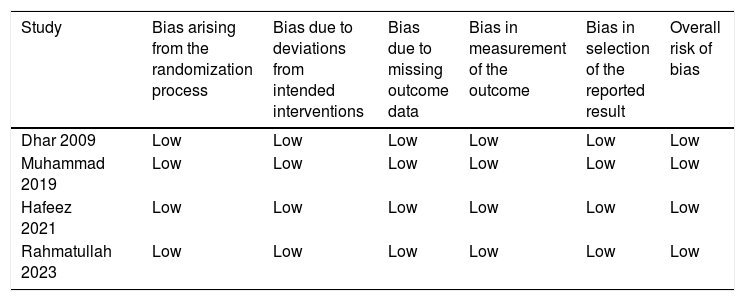
Quality assessmentThe risk-of-bias assessment for the individual RCTs is summarized in Table 2. Most domains were judged to be at low risk of bias. Because only 4 RCTs were included, publication bias could not be reliably assessed and cannot be excluded.
Risk-of-bias summary for randomized studies (RoB 2).
| Study | Bias arising from the randomization process | Bias due to deviations from intended interventions | Bias due to missing outcome data | Bias in measurement of the outcome | Bias in selection of the reported result | Overall risk of bias |
|---|---|---|---|---|---|---|
| Dhar 2009 | Low | Low | Low | Low | Low | Low |
| Muhammad 2019 | Low | Low | Low | Low | Low | Low |
| Hafeez 2021 | Low | Low | Low | Low | Low | Low |
| Rahmatullah 2023 | Low | Low | Low | Low | Low | Low |
RoB 2 citation: Sterne JAC, Savović J, Page MJ, Elbers RG, Blencowe NS, Boutron I, et al. RoB 2: a revised tool for assessing risk of bias in randomised trials. BMJ. 2019;366:l4898.
Multiple therapeutic options are available for the treatment of cutaneous warts; however, none has proven to be 100% effective. Current guidelines and reviews describe a broad therapeutic spectrum, including topical keratolytic agents (such as salicylic acid), cantharidin-based formulations, immunotherapy (contact sensitizers and intralesional antigens), laser and physical therapies, and topical chemotherapeutic agents such as 5-fluorouracil or tirbanibulin, among others.1,3 Within this broad landscape, cryotherapy with liquid nitrogen and intralesional bleomycin are among the modalities with the highest reported efficacy and are widely used in dermatologic practice, particularly for recalcitrant lesions.3,7
This systematic review specifically evaluated the efficacy profile of intralesional bleomycin compared with cryotherapy in the treatment of common warts, based on randomized controlled trials directly comparing these 2 modalities. Four studies were included, comprising a total of 489 patients. The available randomized trials suggest that intralesional bleomycin may provide greater short-term clearance than cryotherapy. The overall RR was 1.26 (95%CI, 1.16–1.38; P<.00001), indicating a 26% higher probability of complete clearance in the bleomycin-treated group. Importantly, given that the maximum follow-up in the included trials was 12 weeks, these estimates reflect short-term clearance only and should not be interpreted as evidence of cure or durable eradication of warts. Statistical heterogeneity was low (I2=0%), which supports the consistency of the findings. Nevertheless, the small number of trials and patients limits the robustness and generalizability of the results.
Hafeez et al. reported that intralesional bleomycin achieved significantly higher cure rates for palmoplantar warts than cryotherapy, with fewer treatment sessions required.8 Similarly, Muhammad et al. confirmed this trend, demonstrating notable efficacy of bleomycin and a lower short-term recurrence rate, although local adverse events such as transient pain and mild residual hyperpigmentation were observed.2 In contrast, Dhar et al. noted that although both therapies are painful and require analgesic precautions, intralesional bleomycin may offer logistical advantages in settings with limited infrastructure because of its easier storage and lower technical requirements compared with cryotherapy.3 Rahmatullah et al. supported bleomycin as an effective alternative for persistent warts, emphasizing the importance of the administration technique (direct intralesional injection vs multipuncture) as a key determinant of therapeutic success.6
From a safety perspective, all RCTs reported local adverse events in both treatment groups. Procedure-related pain was the most frequent adverse event and tended to be more intense with intralesional bleomycin, although it was generally transient and self-limited. Pigmentary changes, superficial ulceration or necrosis, and residual scarring were reported in a minority of patients, with most events resolving without major sequelae.2,3,6,8 No systemic toxicity attributable to bleomycin was documented. However, the heterogeneity and incompleteness of safety reporting prevented a formal pooled analysis and should be considered when interpreting the balance between benefits and harms. Therefore, in routine practice, any potential advantage in short-term clearance with intralesional bleomycin needs to be carefully balanced against its greater procedure-related pain and local adverse events, particularly in patients with low pain tolerance or multiple lesions.
This review has important limitations. First, there was clinical heterogeneity in the bleomycin doses used (ranging from approximately 0.1–1U/mL), differences in application techniques (direct intralesional injection vs multipuncture approaches), and variability in cryotherapy protocols (number of freeze–thaw cycles, duration, and interval between sessions). Second, some of the included studies had suboptimal methodological quality, including the absence of proper sample size calculation and inconsistent categorization of adverse events. These factors limit the strength of causal inferences and hinder a comprehensive risk–benefit analysis. Third, and most importantly, follow-up periods were short (2–12 weeks) and were not evaluated homogeneously across studies, which precludes a reliable assessment of long-term outcomes such as recurrence, a key endpoint in wart management. As a result, our findings should be interpreted as reflecting mainly short-term clearance rather than durable cure.2,3,6,8 Taken together, these issues indicate that the overall certainty of the available evidence is low, despite the low statistical heterogeneity observed in the pooled analyses.
From a clinical perspective, our results suggest that intralesional bleomycin may be associated with higher short-term clearance rates than cryotherapy in patients with common warts. However, given the limited number of heterogeneous RCTs, short follow-up, and variability in dosing and technique, these data do not support a categorical recommendation of intralesional bleomycin as the universally preferred initial strategy for all patients. Instead, intralesional bleomycin should be considered a therapeutic option – particularly for recalcitrant, multiple, or painful warts, or when cryotherapy has failed or is poorly tolerated – within the broader therapeutic landscape that also includes topical keratolytic agents, immunotherapy, laser therapy, and other modalities. Treatment choice should be individualized, considering efficacy, safety profile, availability of resources, clinician experience, and patient preferences.
Future multicenter randomized trials with standardized bleomycin dosing and administration protocols, harmonized cryotherapy regimens, and longer follow-up are needed to confirm these findings, compare recurrence rates, and provide a more precise estimate of the long-term risk–benefit balance of intralesional bleomycin versus cryotherapy and other treatment options.
ConclusionsOur results suggest that, in the short term, intralesional bleomycin may be associated with higher clearance rates than cryotherapy in the treatment of common warts. However, these findings are derived from a small number of heterogeneous randomized trials with relatively short follow-up (up to 12 weeks), and recurrence and long-term control could not be adequately assessed. The certainty of the evidence is therefore low, and no firm recommendations regarding first-line treatment can be made on the basis of this meta-analysis alone.
In clinical decision-making, any potential gain in short-term clearance with intralesional bleomycin should be weighed against its greater procedure-related pain and local adverse events, as well as the availability of resources, clinician experience, and individual patient preferences. Further high-quality, multicenter trials with standardized dosing and administration techniques, harmonized cryotherapy protocols, and longer follow-up are warranted to confirm or refute these results, better characterize the safety profile of intralesional bleomycin, and clarify its place among the various available treatments for common warts.
Ethical approvalThis study is a systematic review and meta-analysis of published data; it did not directly involve human participants and therefore did not require ethics approval.
FundingNone declared.
Conflict of interestNone declared.
Data availabilityThe data that support the findings of this study are available from the corresponding author upon reasonable request.
Uncited references9,10.
The following are the supplementary data to this article: