

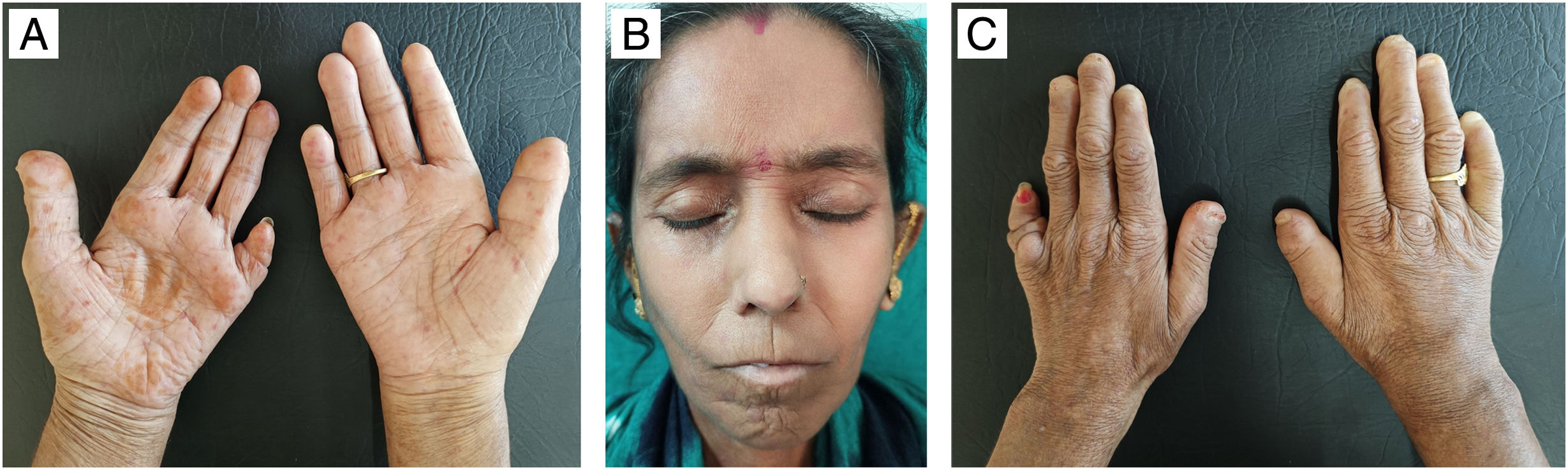
A 50-year-old woman presented with a 2-year history of hand joint deformity and a 20-year history of Raynaud phenomenon. She had experienced shortness of breath and difficulty swallowing solid food for 2 years. Her vital signs were within normal limits. Mucocutaneous examination revealed bound-down skin over the forehead, neck, upper back, forearms, and distal parts of the legs and feet. Well-defined purpuric lesions (mat-like telangiectasias) were present on the palms and face (Fig. 1A, B). Sclerodactyly with resorption of the digits and acro-osteolysis of the left fifth digit was observed (Fig. 1C). Radiographic examination showed resorption of the digits of the hands, decreased interphalangeal joint spaces, and periosteal osteopenia. Antinuclear antibody (ANA) testing was positive with a centromere pattern; therefore, a diagnosis of diffuse progressive scleroderma was established.

Mat-like telangiectasias are common signs of the microvascular changes associated with scleroderma and represent an important early clinical marker for assessing vascular involvement in systemic sclerosis. Various studies have revealed a significant association between multiple telangiectasias and isolated pulmonary hypertension, a major risk factor for mortality in patients with scleroderma. The presence of abundant mat-like telangiectasias on the face and palms in the present case was associated with advanced-stage scleroderma and suggested severe vasculopathy.