


Hidradenitis suppurativa (HS) is a chronic, relapsing, immune-mediated inflammatory skin disease that substantially affects patients’ quality of life.1 According to the European S2k guidelines, oral acitretin at doses of 0.25–0.50mg/kg/day for 3–12 months is considered a third-line treatment, primarily for early-stage, mild-to-moderate disease and the scarring folliculitis phenotype.1,2 However, the published evidence remains limited and heterogeneous.
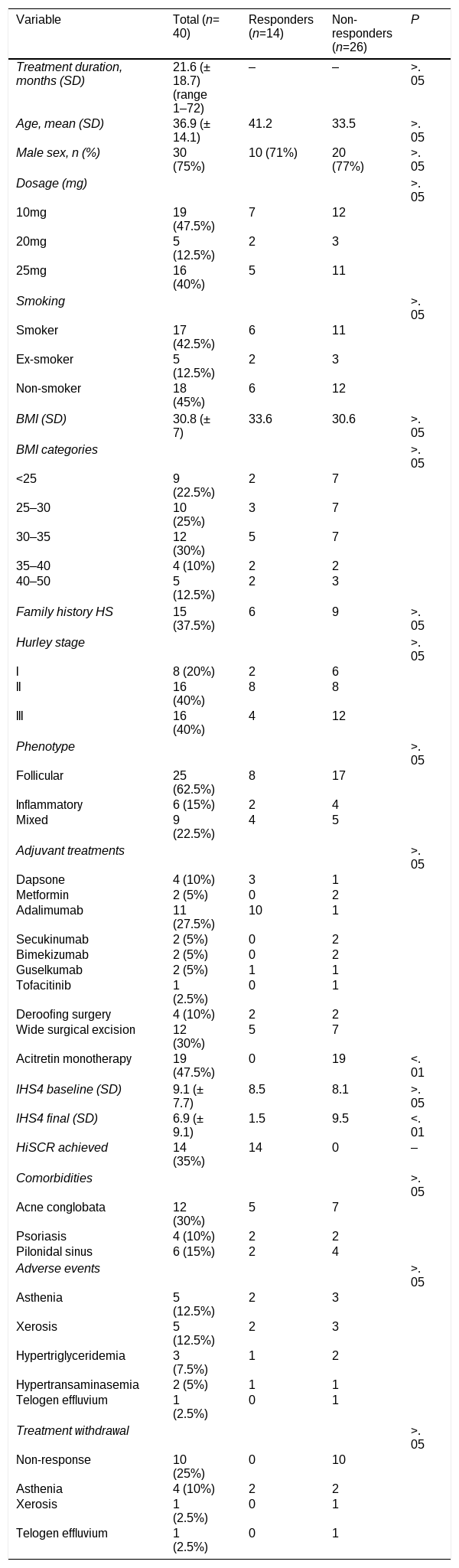
We conducted a retrospective descriptive study of 40 patients with HS treated with acitretin (10–25mg/day). Clinical and demographic characteristics are summarized in Table 1. Nineteen patients (47.5%) received acitretin monotherapy, and none responded. Fourteen patients (35%) achieved Hidradenitis Suppurativa Clinical Response (HiSCR) and a 55% reduction in the International Hidradenitis Suppurativa Severity Score System score (IHS4-55). Baseline characteristics were compared between responders (n=14) and nonresponders (n=26). Responders were older on average than nonresponders (mean age, 41.2 vs 33.5 years; P>.05) and had a slightly higher mean body mass index (33.6 vs 30.6kg/m2; P>.05). Baseline IHS4 scores were similar between groups (8.5 vs 8.1; P>.05). At the final follow-up, responders had markedly lower disease activity than nonresponders (mean IHS4 score, 1.5 vs 9.5; P<.01). No statistically significant between-group differences were observed in sex, smoking status, family history of HS, Hurley stage, or clinical phenotype (all P>.05). A higher proportion of responders received concomitant systemic treatments, particularly biologic agents, whereas acitretin monotherapy was more common among nonresponders. Responders predominantly had follicular (n=8) or mixed (n=7) phenotypes, Hurley stage II (n=8) or III (n=6), and received concomitant adalimumab (n=10), dapsone (n=3), or guselkumab (n=1). No clinical predictors of treatment efficacy were identified. Reported adverse events included asthenia (n=5), xerosis (n=5), hypertriglyceridemia (n=3), elevated transaminase levels (n=2), and telogen effluvium (n=1).
Baseline characteristics and outcomes according to treatment response.
| Variable | Total (n=40) | Responders (n=14) | Non-responders (n=26) | P |
|---|---|---|---|---|
| Treatment duration, months (SD) | 21.6 (± 18.7)(range 1–72) | – | – | >.05 |
| Age, mean (SD) | 36.9 (± 14.1) | 41.2 | 33.5 | >.05 |
| Male sex, n (%) | 30 (75%) | 10 (71%) | 20 (77%) | >.05 |
| Dosage (mg) | >.05 | |||
| 10mg | 19 (47.5%) | 7 | 12 | |
| 20mg | 5 (12.5%) | 2 | 3 | |
| 25mg | 16 (40%) | 5 | 11 | |
| Smoking | >.05 | |||
| Smoker | 17 (42.5%) | 6 | 11 | |
| Ex-smoker | 5 (12.5%) | 2 | 3 | |
| Non-smoker | 18 (45%) | 6 | 12 | |
| BMI (SD) | 30.8 (± 7) | 33.6 | 30.6 | >.05 |
| BMI categories | >.05 | |||
| <25 | 9 (22.5%) | 2 | 7 | |
| 25–30 | 10 (25%) | 3 | 7 | |
| 30–35 | 12 (30%) | 5 | 7 | |
| 35–40 | 4 (10%) | 2 | 2 | |
| 40–50 | 5 (12.5%) | 2 | 3 | |
| Family history HS | 15 (37.5%) | 6 | 9 | >.05 |
| Hurley stage | >.05 | |||
| I | 8 (20%) | 2 | 6 | |
| II | 16 (40%) | 8 | 8 | |
| III | 16 (40%) | 4 | 12 | |
| Phenotype | >.05 | |||
| Follicular | 25 (62.5%) | 8 | 17 | |
| Inflammatory | 6 (15%) | 2 | 4 | |
| Mixed | 9 (22.5%) | 4 | 5 | |
| Adjuvant treatments | >.05 | |||
| Dapsone | 4 (10%) | 3 | 1 | |
| Metformin | 2 (5%) | 0 | 2 | |
| Adalimumab | 11 (27.5%) | 10 | 1 | |
| Secukinumab | 2 (5%) | 0 | 2 | |
| Bimekizumab | 2 (5%) | 0 | 2 | |
| Guselkumab | 2 (5%) | 1 | 1 | |
| Tofacitinib | 1 (2.5%) | 0 | 1 | |
| Deroofing surgery | 4 (10%) | 2 | 2 | |
| Wide surgical excision | 12 (30%) | 5 | 7 | |
| Acitretin monotherapy | 19 (47.5%) | 0 | 19 | <.01 |
| IHS4 baseline (SD) | 9.1 (± 7.7) | 8.5 | 8.1 | >.05 |
| IHS4 final (SD) | 6.9 (± 9.1) | 1.5 | 9.5 | <.01 |
| HiSCR achieved | 14 (35%) | 14 | 0 | – |
| Comorbidities | >.05 | |||
| Acne conglobata | 12 (30%) | 5 | 7 | |
| Psoriasis | 4 (10%) | 2 | 2 | |
| Pilonidal sinus | 6 (15%) | 2 | 4 | |
| Adverse events | >.05 | |||
| Asthenia | 5 (12.5%) | 2 | 3 | |
| Xerosis | 5 (12.5%) | 2 | 3 | |
| Hypertriglyceridemia | 3 (7.5%) | 1 | 2 | |
| Hypertransaminasemia | 2 (5%) | 1 | 1 | |
| Telogen effluvium | 1 (2.5%) | 0 | 1 | |
| Treatment withdrawal | >.05 | |||
| Non-response | 10 (25%) | 0 | 10 | |
| Asthenia | 4 (10%) | 2 | 2 | |
| Xerosis | 1 (2.5%) | 0 | 1 | |
| Telogen effluvium | 1 (2.5%) | 0 | 1 | |
HS: hidradenitis suppurativa; BMI: body mass index; IHS4: International Hidradenitis Suppurativa Severity Score System; HiSCR: hidradenitis suppurativa clinical response; SD: standard deviation.
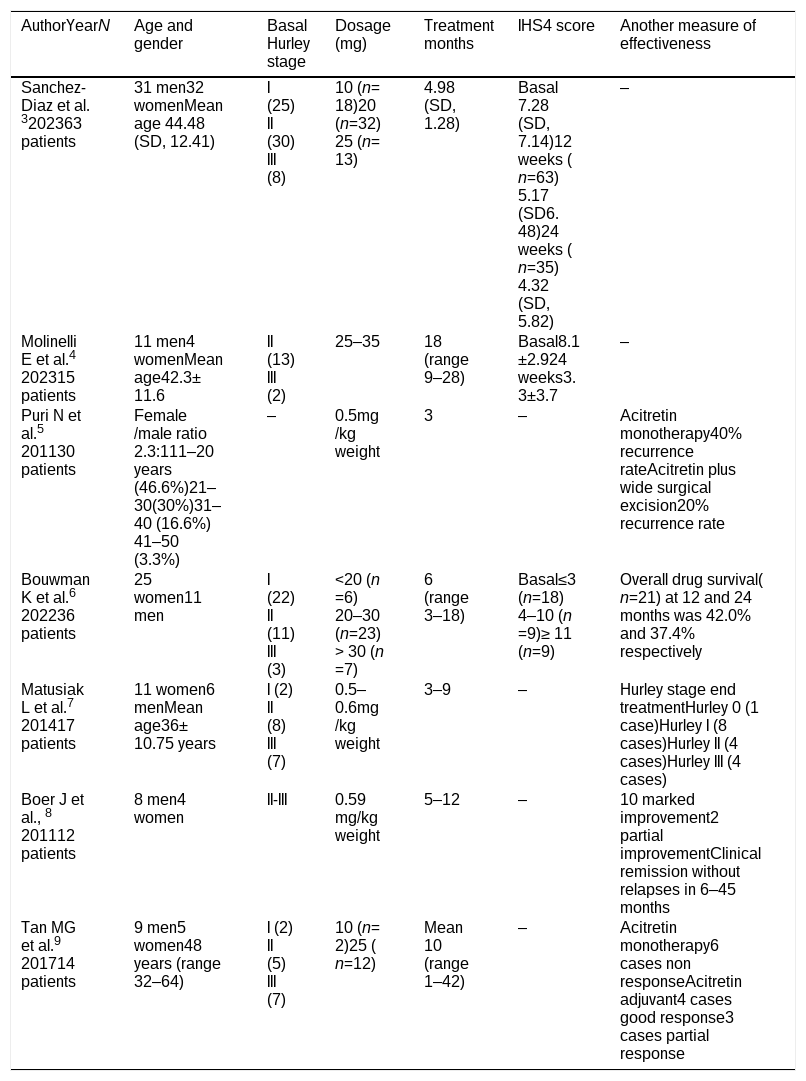
Former studies of acitretin for HS (summarized in Table 2)3–9 have reported inconsistent outcomes, largely because of heterogeneity in clinical phenotype, dosing, concomitant treatments, and response criteria. Combination treatment with systemic antibiotics, biologic agents, or wide surgical excision has been associated with greater efficacy and lower relapse rates, particularly in Hurley stages I–II.3,5,6,9 In our series, better outcomes were observed among patients with Hurley stage II–III disease and follicular or mixed phenotypes who received concomitant adalimumab.
results of case series studies with acitretin for HS.3–9
| AuthorYearN | Age and gender | Basal Hurley stage | Dosage (mg) | Treatment months | IHS4 score | Another measure of effectiveness |
|---|---|---|---|---|---|---|
| Sanchez-Diaz et al.3202363 patients | 31 men32 womenMean age 44.48 (SD, 12.41) | I (25)II (30)III (8) | 10 (n=18)20 (n=32)25 (n=13) | 4.98(SD, 1.28) | Basal 7.28(SD, 7.14)12 weeks (n=63)5.17 (SD6.48)24 weeks (n=35)4.32 (SD, 5.82) | – |
| Molinelli E et al.4202315 patients | 11 men4 womenMean age42.3±11.6 | II (13)III (2) | 25–35 | 18 (range 9–28) | Basal8.1±2.924 weeks3.3±3.7 | – |
| Puri N et al.5201130 patients | Female/male ratio 2.3:111–20 years (46.6%)21–30(30%)31–40 (16.6%)41–50 (3.3%) | – | 0.5mg/kg weight | 3 | – | Acitretin monotherapy40% recurrence rateAcitretin plus wide surgical excision20% recurrence rate |
| Bouwman K et al.6202236 patients | 25 women11 men | I (22)II (11)III (3) | <20 (n=6)20–30 (n=23)> 30 (n=7) | 6 (range 3–18) | Basal≤3 (n=18)4–10 (n=9)≥ 11 (n=9) | Overall drug survival(n=21) at 12 and 24 months was 42.0% and 37.4% respectively |
| Matusiak L et al.7201417 patients | 11 women6 menMean age36±10.75 years | I (2)II (8)III (7) | 0.5–0.6mg/kg weight | 3–9 | – | Hurley stage end treatmentHurley 0 (1 case)Hurley I (8 cases)Hurley II (4 cases)Hurley III (4 cases) |
| Boer J et al., 8201112 patients | 8 men4 women | II-III | 0.59mg/kg weight | 5–12 | – | 10 marked improvement2 partial improvementClinical remission without relapses in 6–45 months |
| Tan MG et al.9201714 patients | 9 men5 women48 years (range 32–64) | I (2)II (5)III (7) | 10 (n=2)25 (n=12) | Mean 10 (range 1–42) | – | Acitretin monotherapy6 cases non responseAcitretin adjuvant4 cases good response3 cases partial response |
N: number of cases; IHS4 score: International Hidradenitis Suppurativa Severity Score System; SD: standard deviation.
Clinical improvement typically occurs within 3–6 months of treatment, with reductions of 3–5 points in the International Hidradenitis Suppurativa Severity Score System (IHS4) reported.3,4 The safety profile is generally acceptable; adverse effects include xerosis, xerostomia, cheilitis, asthenia, and hypertriglyceridemia. Lack of efficacy is the most common reason for discontinuation.3–9 Because of its teratogenicity, acitretin requires strict pregnancy-prevention measures, including contraception for 3 years after treatment discontinuation.2
Potential predictors of response include higher baseline IHS4 scores, a family history of HS, the follicular phenotype, and a history of follicular occlusion disorders (e.g., acne conglobata or pilonidal sinus).1–3,6 Acitretin may act by reducing follicular hyperkeratosis and obstruction and exerting anti-inflammatory and immunomodulatory effects through regulation of interleukin 6, interleukin 36, MRP-8, and interferon γ, as well as inhibition of neutrophil chemotaxis and proinflammatory mediators.2,3,6
Given its immunomodulatory but nonimmunosuppressive profile, acitretin may be a useful treatment alternative in selected patients, such as those with cancer, older adults, or patients with chronic infections, and it may have a role in chemoprevention of cutaneous squamous cell carcinoma. This study is limited by its retrospective design and small sample size. Further research is needed to optimize dosing, treatment duration, and combination regimens and to assess long-term outcomes.
In conclusion, acitretin may be a safe and effective adjunct to adalimumab in patients with follicular or mixed HS phenotypes and Hurley stage II–III disease. Some studies have reported efficacy of acitretin monotherapy in patients with mild-to-moderate follicular disease. For patients with inflammatory phenotypes or severe disease, acitretin may be useful as an adjunct to biologic therapy to improve treatment efficacy.
Conflict of interestThe authors declare that they have no conflict of interest.